
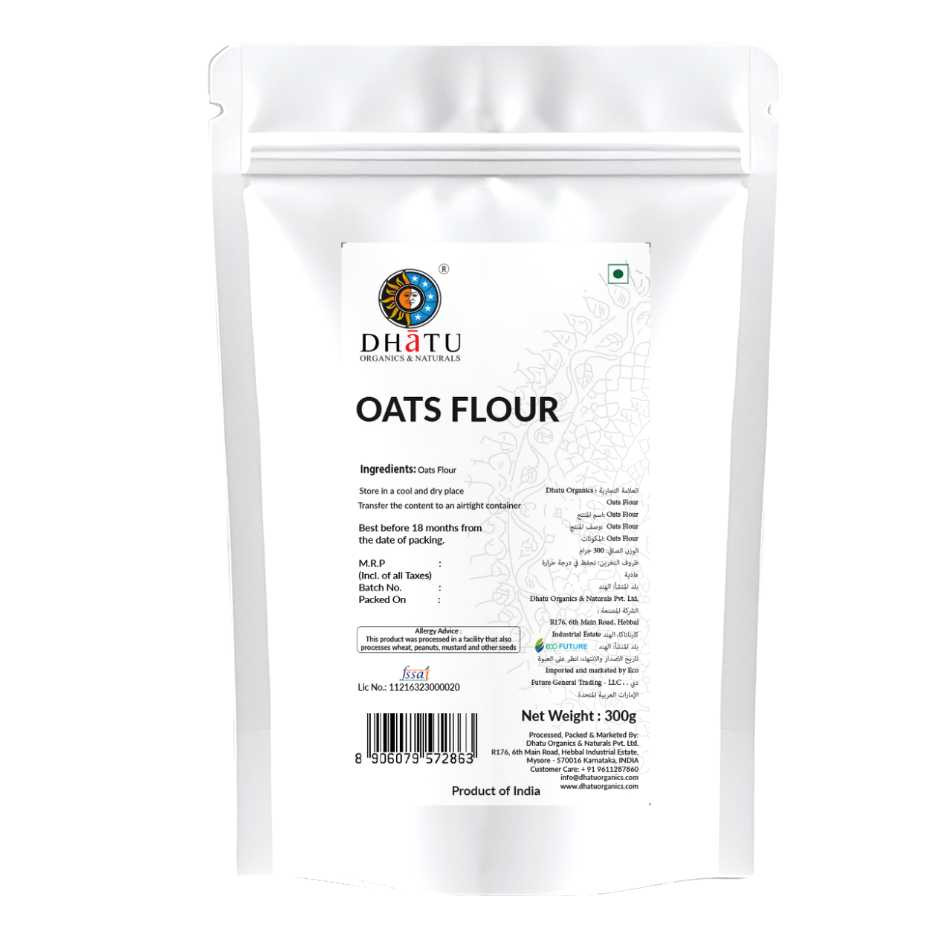
Product description
WHOLE GRAIN, GROUND FROM OAT GROATS
This flour is ground from oat groats — hulled, cleaned whole oats — retaining the bran, germ, and endosperm intact, unlike refined flours such as maida which lose the bran and germ during milling. Oat flour adds a rich, nutty flavour and noticeable texture to breads and other baked goods, and tends to produce results that are moister and more crumbly than items baked purely with wheat flour, while also retaining freshness longer.
BETA-GLUCAN — A GENUINELY STRONG FIBRE STORY
Oats are particularly well known among whole grains for their beta-glucan content — a soluble fibre that has been specifically and repeatedly studied for its association with reduced LDL (“bad”) cholesterol levels. This is one of the more evidence-backed fibre stories in nutrition science, not a generic wellness claim, and it's a genuine point of differentiation between oat flour and most wheat-based flours.
NATURALLY GLUTEN-FREE — WITH AN HONEST CAVEAT
Oats themselves are a naturally gluten-free grain. However, oats are very commonly grown, transported, and processed alongside wheat, barley, or rye, which means cross-contamination is a genuinely common issue across the oat industry — not a fringe concern.
BAKING WITH OAT FLOUR — WHAT TO EXPECT
Because oat flour lacks gluten, it cannot rise on its own the way wheat flour does, and must be combined with wheat flour to produce a properly leavened bread. A reliable starting ratio is roughly 3 parts wheat flour to 1 part oat flour, adjusting to taste and texture preference. For best results, oat flour is often freshest when ground just before use, though pre-ground flour like this one is a convenient, ready-to-use alternative.
HOW TO USE
- Best blended with wheat flour for leavened baking, or used on its own in recipes that don't require rise.
- Pancakes and waffles: oat flour adds moisture and a subtle nutty flavour, working well even as the primary flour.
- Muffins and quick breads: blended with wheat flour (roughly 1 part oat to 3 parts wheat) for a moister, longer-lasting crumb.
- Cookies: a partial substitution adds chewiness and a deeper flavour.
- Baby food and porridge thickening: a mild, naturally sweet flour well suited to simple infant recipes (always follow your paediatrician's guidance on introducing new grains).
- Smoothies: a spoonful blended in for added fibre and a thicker texture.
- Coating for baking: used as a coating for fruit before baking into crumbles or pies, helping absorb excess moisture.
- Thickening soups and stews: a small amount whisked in as a natural thickener.
STORAGE
For extended storage, keep oat flour in an airtight container in the freezer, where it will stay fresh for several months — oat flour contains natural oils that can turn rancid more quickly than refined flours if left at room temperature for long periods. For shorter-term use, a cool, dry, airtight container away from direct sunlight is sufficient.
NUTRITION TABLE
Basis: Per 100g
| Nutrient | Per Serving | Per 100g/ ml | % Daily Value* |
|---|---|---|---|
| Energy | - | 379 kcal/ 1590 kJ | 19% |
| Total fat | - | 6.5g | 8% |
| — Total Carbohydrates | - | 68g | 25% |
| — Dietary Fibre | - | 10g | 36% |
| of which Beta-glucan | - | ~4g | - |
| — Sugars | - | 1g | - |
| Protien | - | 13g | 26% |
| Iron | - | 4.3mg | 24% |
| Magnesium | - | 138g | 33% |
| Manganese | - | 3.6mg | 158% |
| Zinc | - | 3.6mg | 33% |