
Product description
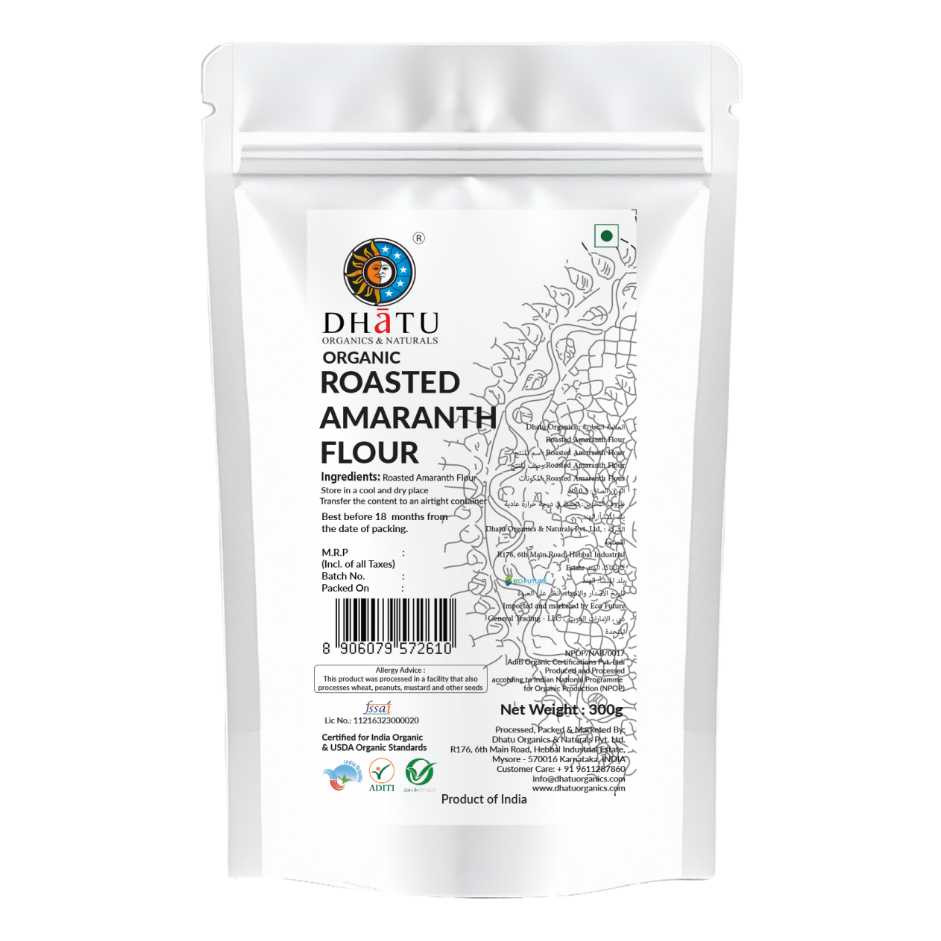
Amaranth is technically a pseudocereal — a seed botanically related to quinoa and spinach rather than a true cereal grain — cultivated for thousands of years across Mesoamerica and South Asia. In India, it's known as rajgira and has a long tradition as a fasting-day staple, used to make puris, parathas, and laddoos during Navratri and Ekadashi. This flour is made from roasted amaranth seeds, milled to a fine, nutty-flavoured powder.
WHY ROASTED, NOT RAW
Roasting amaranth seeds before milling serves two genuine purposes: it deepens and develops the seed's natural nutty flavour, and it's associated with reducing naturally occurring anti-nutrient compounds (such as saponins and trypsin inhibitors) present in raw amaranth, which can otherwise interfere with protein digestion. This is a meaningful processing choice, not just a flavour preference.
A GENUINELY STRONG, ACCURATELY-TOLD PROTEIN STORY
Amaranth flour provides roughly 13–15g of protein per 100g — among the highest of any gluten-free flour, ahead of rice flour and most wheat-based flours. It's also notably rich in lysine, an essential amino acid that's commonly the limiting factor in cereal grains like wheat, rice, and maize. Peer-reviewed amino acid scoring research shows amaranth protein is limited by valine rather than lysine, with an amino acid score of approximately 74% — meaning it falls just short of the strict technical definition of a “complete protein,” even though it remains one of the most well-rounded plant protein sources available. We'd rather tell you the precise, accurate version of this story than the oversimplified one.
SQUALENE, FIBRE, AND HEART HEALTH — THE RESEARCH-SUPPORTED VERSION
Amaranth naturally contains squalene, a compound that's a biosynthetic precursor to cholesterol and has been studied for various biological activities, along with dietary fibre that's mechanistically linked to LDL cholesterol management through bile-acid binding — a well-established general nutrition mechanism. These are genuine, research-supported properties of amaranth as a food, though we'd stop short of promising a specific personal cholesterol outcome from any single ingredient; overall diet pattern matters far more than any one flour.
MINERALS — IRON, CALCIUM, AND MAGNESIUM
Amaranth is also a genuinely good source of iron, calcium, and magnesium — notably, its calcium content is higher than quinoa's, a useful comparison point for customers exploring gluten-free, plant-based mineral sources. Combined with its naturally gluten-free status, this makes amaranth flour a nutritionally substantial choice well beyond its traditional fasting-season use.
HOW TO USE— NUTRIENT-DENSE & VERSATILE
- Best blended with other flours for everyday use, or enjoyed on its own in traditional fasting recipes.
- Rajgira puri and paratha: the traditional fasting-day preparation, often used on its own or with a small amount of potato as a binder.
- Rajgira laddoo: a classic Indian sweet, traditionally made with puffed amaranth and jaggery.
- Roti and chapati: blended at roughly 20–30% with whole wheat flour for added protein and a nutty depth of flavour.
- Pancakes: blended into a batter for a protein-rich breakfast.
- Baked goods: added to muffins, cookies, or energy bars for a nutritional boost and distinctive flavour.
- Thickening soups and sauces: used in small quantities as a natural, gluten-free thickener.
- Smoothies: a spoonful blended in for added protein and texture.
STORAGE
Store in a cool, dry place away from moisture and humidity, ideally in an airtight metal or glass container, since milled amaranth flour can be more sensitive to moisture than whole seeds.
| Nutrient | Per Serving | Per 100g | % Daily Value* |
|---|---|---|---|
| Energy | - | ~371 kcal | 19% |
| Total fat | - | 6-7g | 9% |
| Total Carbs | - | 65-68g | 24% |
| — Dietary Fibre | - | 7g | 25% |
| Protein | 13-15g | 27% | |
| Calcium | - | 159mcg | 12% |
| Iron | - | Present | - |


