
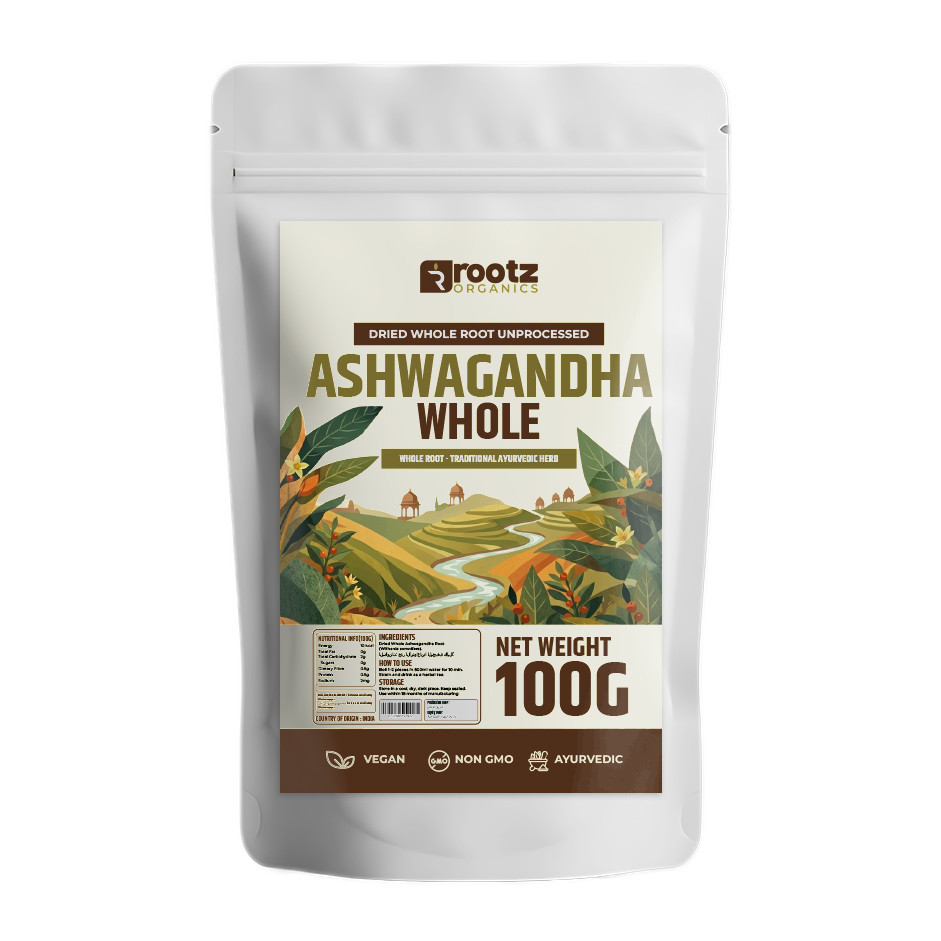
Product description
In Ayurvedic tradition, the whole root is considered the purest form of ashwagandha. Before extracts, before capsules, before standardised powders — there was the root. Dried, stored, and boiled into preparations that practitioners administered across generations for vitality, recovery, and mental clarity.
Rootz Ashwagandha Whole Root is as close to that tradition as you can get today. We source premium-quality Withania somnifera roots — selected for size, colour, and aroma — and sun-dry them slowly to preserve their natural withanolide content without exposure to industrial heat.
What you receive is a pack of dried whole roots with the natural, earthy, slightly bitter aroma of genuine ashwagandha — a smell that every Ayurveda practitioner would recognise immediately.
HOW TO USE THE WHOLE ROOT
Traditional herbal tea (kadha): Place 1–2 root pieces in 500ml of water. Bring to a boil, then simmer on low heat for 10–15 minutes. Strain and consume while warm. Add raw honey, cardamom, or A2 milk to taste.
Milk preparation (ksheer paka): Simmer 1 root piece in 250ml A2 milk on low heat for 15–20 minutes until the milk reduces slightly. Strain, add honey, and drink before bed. This is the classical Ayurvedic preparation for ashwagandha.
Herbal infusion blend: Combine with dried tulsi leaves, dried ginger, and cinnamon in water for a complete wellness tea. Each ingredient amplifies the other.
WHO CHOOSES WHOLE ROOT OVER POWDER
Whole root is preferred by:
- Ayurvedic practitioners who work with traditional preparations
- Wellness enthusiasts who value the ritual of preparing their herbs
- Consumers who prefer seeing and interacting with the unprocessed plant
- Those who brew herbal teas regularly and want to add ashwagandha to existing preparations
The powder is more convenient for daily use in milk or smoothies. The whole root is the more authentic, more ritual-oriented form — and for many, that distinction matters.
INGREDIENTS
Whole dried Ashwagandha root (Withania somnifera). Sun-dried. No additives. No preservatives. Vegan.
Nutrition
Servings per 100g
| Nutrient | Value | % Daily Value |
|---|---|---|
| Energy | 245 kcal | 0% |
| Saturated Fat | 0.5g | 0% |
Withanolides (active compound) | ~0.3–0.5% dry weight | — |
| Iron | 15mg | 2% |
| Total Carbohydrate | 40g | 0% |
| Dietary Fiber | 16g | 1% |
| Calcium | 320mg | 1% |
| Protein | 12g | 0% |
Sodium | 65mg | 0% |
STORAGE
Store in an airtight container away from moisture, humidity, and direct sunlight. The dried roots are shelf-stable but sensitive to humidity. Consume within 18 months of the manufacture date printed on pack.
Reviews
Login
Don't have an account?
Sign UpWhole root is the dried, unprocessed root of the Withania somnifera plant. It is used to prepare traditional herbal teas and infusions — boiled in water or milk — exactly as described in classical Ayurvedic texts. Powder is the ground form of the root, which can be stirred directly into drinks or smoothies for faster daily use. The whole root is preferred for traditional ritual preparation, visible authenticity, and herbal tea routines. The KSM-66® powder is preferred for convenience, standardised withanolide content, and use in cold preparations. Both deliver ashwagandha's functional benefits — through different preparations and rituals.
Whole root is the dried, unprocessed root of the Withania somnifera plant. It is used to prepare traditional herbal teas and infusions — boiled in water or milk — exactly as described in classical Ayurvedic texts. Powder is the ground form of the root, which can be stirred directly into drinks or smoothies for faster daily use. The whole root is preferred for traditional ritual preparation, visible authenticity, and herbal tea routines. The KSM-66® powder is preferred for convenience, standardised withanolide content, and use in cold preparations. Both deliver ashwagandha's functional benefits — through different preparations and rituals.
Place 1–2 pieces of dried ashwagandha root in 500ml of water. Bring to a boil over medium heat, then reduce to a low simmer for 10–15 minutes — you will see the water take on an earthy golden-brown colour and the distinctive ashwagandha aroma will be released. Strain into a cup. Add raw honey, a pinch of cardamom, or a splash of A2 milk to taste. For a more concentrated preparation (ksheer paka), simmer 1 root piece in 250ml of A2 milk for 15–20 minutes until the milk reduces. This is the traditional Ayurvedic preparation.
Place 1–2 pieces of dried ashwagandha root in 500ml of water. Bring to a boil over medium heat, then reduce to a low simmer for 10–15 minutes — you will see the water take on an earthy golden-brown colour and the distinctive ashwagandha aroma will be released. Strain into a cup. Add raw honey, a pinch of cardamom, or a splash of A2 milk to taste. For a more concentrated preparation (ksheer paka), simmer 1 root piece in 250ml of A2 milk for 15–20 minutes until the milk reduces. This is the traditional Ayurvedic preparation.
Yes. Ashwagandha whole root has been used in daily wellness rituals in Ayurvedic practice for thousands of years. A standard preparation of 1–2 root pieces (approximately 2–4g) per day in herbal tea or milk is the typical approach. As with the powder form, it is not recommended during pregnancy or breastfeeding, and those on prescription medication should consult their healthcare provider before beginning regular use. For healthy adults, it has a well-established traditional and safety record at normal daily amounts.
Yes. Ashwagandha whole root has been used in daily wellness rituals in Ayurvedic practice for thousands of years. A standard preparation of 1–2 root pieces (approximately 2–4g) per day in herbal tea or milk is the typical approach. As with the powder form, it is not recommended during pregnancy or breastfeeding, and those on prescription medication should consult their healthcare provider before beginning regular use. For healthy adults, it has a well-established traditional and safety record at normal daily amounts.
Yes — the naturally bitter, slightly earthy taste of ashwagandha tea is completely normal and is an indicator of the genuine withanolide compounds present in the root. Bitterness in traditional Ayurvedic herbs is considered a functional quality, not a defect. To balance the taste: add raw honey (do not use refined sugar), a pinch of cardamom, or A2 milk. The milk-based preparation (ksheer paka) is traditionally preferred partly because the milk fat helps carry the fat-soluble compounds from the root and also rounds out the bitterness pleasantly.
Yes — the naturally bitter, slightly earthy taste of ashwagandha tea is completely normal and is an indicator of the genuine withanolide compounds present in the root. Bitterness in traditional Ayurvedic herbs is considered a functional quality, not a defect. To balance the taste: add raw honey (do not use refined sugar), a pinch of cardamom, or A2 milk. The milk-based preparation (ksheer paka) is traditionally preferred partly because the milk fat helps carry the fat-soluble compounds from the root and also rounds out the bitterness pleasantly.


