
Product description
THE BIFIDOGENIC PREBIOTIC ADVANTAGE
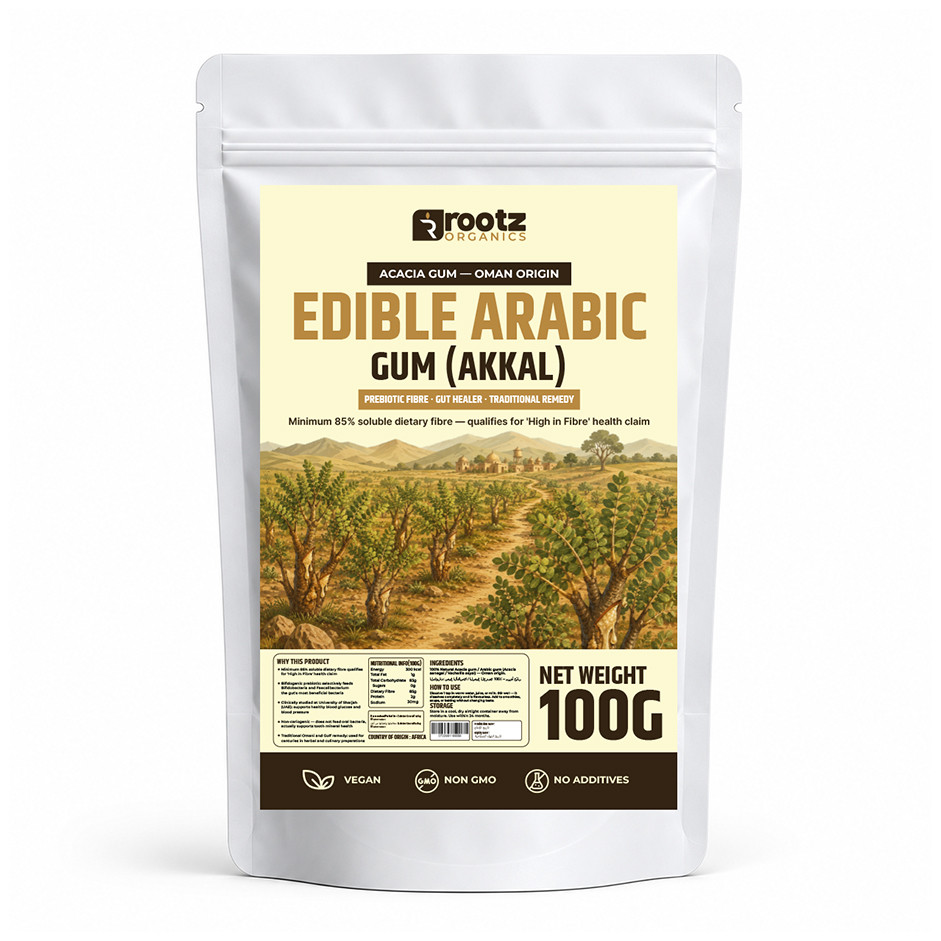
Acacia gum has been extensively studied as a prebiotic. Unlike inulin and FOS (which ferment quickly and can cause bloating), acacia gum ferments slowly and selectively — primarily feeding Bifidobacteria and Faecalibacterium prausnitzii, the two most beneficial bacterial species in the human gut.
F. prausnitzii specifically:
- Produces butyrate (the primary energy source for colonocytes)
- Anti-inflammatory properties in the gut
- Lower levels are consistently associated with IBD, Crohn's disease, and colitis
- Acacia gum is one of the few prebiotics that specifically and consistently increases F. prausnitzii
CLINICAL EVIDENCE:
- University of Sharjah study: significant improvements in blood glucose and systolic blood pressure in healthy volunteers
- Multiple studies show prebiotic effect with 10g/day dose
- Non-cariogenic: does not feed oral bacteria that cause tooth decay — actually supports tooth mineral health
TRADITIONAL GULF USE:
Akkal is consumed traditionally throughout the Gulf region — dissolved in water or milk, chewed as a resin, or added to traditional herbal preparations. It has been used for centuries for digestive support, oral health, and as a wound-healing agent.
HOW TO USE
- Dissolve 1 tsp (5–10g) in warm water, juice or milk — it stirs completely clear and is virtually flavourless
- Add to smoothies, laban, soups (shorba) or baking without changing the taste
- Traditional Gulf practice: dissolved in water or milk, or stirred into herbal preparations
- Start with 5g/day and build to 10g/day over 2 weeks to let gut bacteria adapt
STORAGE
Cool, dry, airtight container. 24 months sealed.
INGREDIENTS
100% Natural acacia gum / Arabic gum (Acacia senegal / Vachellia seyal) — Oman origin.
Reviews
Login
Don't have an account?
Sign UpAkkal (acacia gum / Arabic gum) is the dried resin of Acacia senegal / Vachellia seyal trees — a water-soluble dietary fibre resin. Mastic (mastika) is the resin of Pistacia lentiscus — primarily used for flavour (slightly pine-like and bitter), not dissolved as a dietary fibre supplement. Different plants, different uses, different nutritional profiles.Akkal (acacia gum / Arabic gum) is the dried resin of Acacia senegal / Vachellia seyal trees — a water-soluble dietary fibre resin. Mastic (mastika) is the resin of Pistacia lentiscus — primarily used for flavour (slightly pine-like and bitter), not dissolved as a dietary fibre supplement. Different plants, different uses, different nutritional profiles.
Acacia gum is a high-molecular-weight, highly branched polysaccharide that ferments more slowly and gradually in the gut compared to short-chain fibres like inulin. The slow, selective fermentation feeds specific bacterial species without producing the rapid CO2 and hydrogen gas that cause bloating with inulin and FOS supplements.Acacia gum is a high-molecular-weight, highly branched polysaccharide that ferments more slowly and gradually in the gut compared to short-chain fibres like inulin. The slow, selective fermentation feeds specific bacterial species without producing the rapid CO2 and hydrogen gas that cause bloating with inulin and FOS supplements.
Measurable changes in gut microbiome composition (increased Bifidobacteria and F. prausnitzii) are seen in studies after 4 weeks of consistent use at 10g/day. For digestive comfort improvements (reduced bloating, improved regularity): 2–4 weeks. Start with 5g/day for the first two weeks to allow gradual gut adaptation.Measurable changes in gut microbiome composition (increased Bifidobacteria and F. prausnitzii) are seen in studies after 4 weeks of consistent use at 10g/day. For digestive comfort improvements (reduced bloating, improved regularity): 2–4 weeks. Start with 5g/day for the first two weeks to allow gradual gut adaptation.