
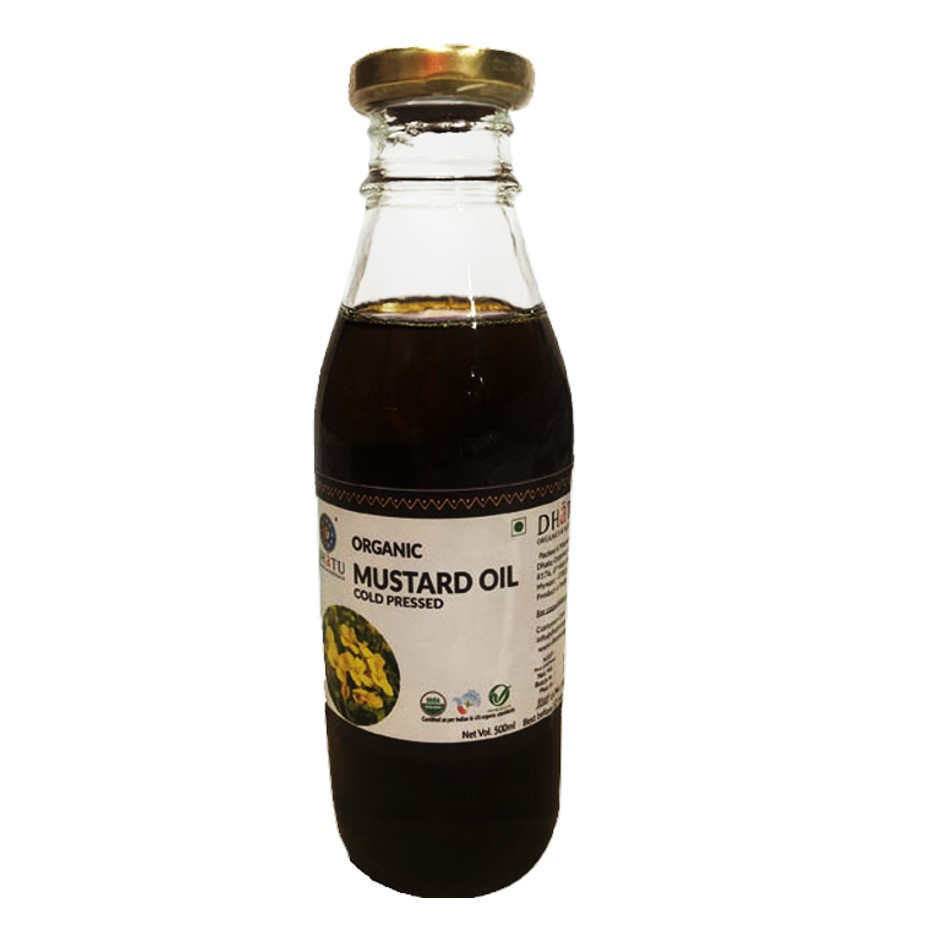
Product description
KACHI GHANI — THE TRADITIONAL COLD-PRESSING METHOD
Kachi Ghani refers to a traditional cold-pressing method long used in Indian mustard oil production, where seeds are pressed at low temperature using a wood or stone mill rather than high-speed, heat-generating modern expellers. This gentler process preserves more of the oil's natural pungency, aroma, and character than expeller-pressed or refined alternatives — it is part of why traditional mustard oil has such a distinctive, sharp flavour compared to milder, more processed versions sold in some supermarkets.
ORGANICALLY GROWN MUSTARD SEEDS
Made from organically grown mustard seeds.
ABOUT COOKING USE
Pure, cold-pressed mustard oil contains erucic acid, a fatty acid that the US and EU restrict for cooking use based on animal studies. However, no adverse effects have been proven in humans at normal consumption levels, and mustard oil remains a trusted cooking staple across South Asia for generations.
THE FLAVOUR PROFILE
A distinctive, pungent, nutty flavour with a sharp character that mellows with heat — the same profile that has made mustard oil a defining ingredient in Bengali, North Indian, and other South Asian culinary traditions for generations.
TRADITIONAL TOPICAL USE
Beyond the kitchen, mustard oil has a long-standing traditional role in South Asian hair and skin care practices, commonly used as a massage oil or scalp treatment. This traditional external use is well established culturally; as with any oil applied to skin, a small patch test is sensible before broader use, particularly for those with sensitive skin.
HOW TO USE
A traditional pantry staple with established culinary and topical uses.
- Tempering: heated until it reaches its smoke point and lightly smokes, then cooled slightly before adding spices — a traditional technique used to mellow the oil's sharpness before cooking.
- Pickling (achaar): a traditional base oil for Indian-style pickles, where its pungency is part of the flavour profile.
- Curries and stir-fries: used as a primary cooking oil in many Bengali and North Indian dishes.
- Tadka/tempering spices: heated with whole spices at the start of cooking to release their aroma.
- Scalp and hair treatment: traditionally massaged into the scalp, sometimes combined with other oils.
- Body massage: used externally as a traditional massage oil in South Asian wellness practices.
- Marinades: blended into marinades where its distinctive flavour is a deliberate ingredient choice.
- Always check current cooking-use guidance for your specific market if you are new to using mustard oil as a cooking ingredient.
STORAGE
Store in a cool, dark place away from direct sunlight and heat. Keep the cap tightly closed after use to limit oxidation.
NUTRITION
| Nutrient | Per 1 tbsp (14g) | Per 100g | % Daily Value* |
|---|---|---|---|
| Energy | 124 kcal / 519 kJ | 884 kcal | 6% |
| Total fat | 14g | 100g | 18% |
| — Saturated fat | 1.7g | 12g | 9% |
| — Monounsaturated fat | General category est | General category est | — |
| — Polyunsaturated fat (Omega-3 & 6) | General category est | General category est | — |
| — Total Carbohydrates | 0g | 0g | 0% |
| Protein | 0g | 0.3g | 0% |
In the UAE, GCC countries, India, and most of Asia, mustard oil is a fully approved edible cooking oil — a staple cooking fat for hundreds of millions of people. The restriction you may have read about applies specifically to the United States and the European Union, where regulatory bodies set limits on erucic acid content in food oils based on rat studies conducted in the 1970s. Those studies used erucic acid at very high doses in isolated rat diets — not comparable to culinary use in a balanced diet. Extensive human data from North India, Bangladesh, and Nepal — where mustard oil has been the primary cooking fat for centuries — does not show the cardiac effects observed in the rat studies. UAE food safety regulations permit mustard oil as an edible cooking oil. This Dhatu mustard oil is NPOP certified organic and is labelled, certified, and legally sold as a food product in the UAE market.
Kachi Ghani refers to the traditional wooden-press cold extraction method — seeds are pressed slowly at 4–6 RPM in a wooden Ghani press without applying external heat. The friction at this low speed does not raise oil temperature above 40–50°C. Standard commercial mustard oil is either expeller-pressed at high speed (generating significant heat, destroying aromatic compounds) or solvent-extracted using hexane (which removes most bioactive compounds and requires deodorisation). Kachi Ghani oil is identifiable by its strong pungency — the characteristic mustard smell is allyl isothiocyanate, largely lost in refining. If a mustard oil has little to no smell, it has been refined. Kachi Ghani oil is also darker in colour — deep amber to amber-green — versus the pale yellow of refined mustard oil.
The pungency comes from allyl isothiocyanate (AITC) — a naturally occurring compound formed when mustard seeds are crushed. It is the same compound that gives Dijon mustard and wasabi their characteristic heat. In raw cold-pressed mustard oil, AITC is at full concentration. When heated, AITC partially volatilises within 30–60 seconds — the sharpest phase of the pungency dissipates into the air. Technique: heat the oil in the pan for 30–60 seconds before adding other ingredients. What remains after this initial heating is a mellower, nutty-spiced base flavour that works with most cuisines. If using raw (in vinaigrettes or marinades), the full pungent character is part of the flavour — it produces a naturally mustardy dressing with no additional condiment needed.
The Omega-6 to Omega-3 ratio is a significant marker of dietary fat quality. The WHO recommends keeping this ratio below 5:1. Most common cooking oils are far outside this range: sunflower oil is approximately 40:1, corn oil is 46:1, and refined vegetable oil blends are typically 10–15:1. Cold-pressed mustard oil has a ratio of approximately 1.5–2:1, because it contains approximately 9% alpha-linolenic acid (ALA, the plant Omega-3) alongside 15% linoleic acid (Omega-6). Among widely available cooking oils, only flaxseed oil and hempseed oil have comparable Omega-3 profiles — but neither can be used for high-heat cooking due to very low smoke points. For a cooking oil that is also stable at 250°C and suitable for daily cooking volume, mustard oil's Omega-6:Omega-3 ratio is without equal in this category.


