
Product description
There is a reason that red chicory has been in continuous use in European herbal medicine for over 2,000 years while most other vegetables have come and gone with dietary trends.
The Egyptians grew it for liver complaints. The Romans used chicory root tea for digestive support. Medieval European herbalists prescribed it for bile production, gallbladder health, and blood purification. The Dutch refined the growing technique to an industrial precision. And modern nutritional science has, largely, confirmed what all of them knew: red chicory is one of the most therapeutically significant vegetables available in fresh form.
Most people in the UAE have never cooked with it. That is the gap this page closes.
THE BITTERNESS IS THE POINT
Red chicory is bitter. This is not a flaw to be apologised for — it is the entire nutritional story.
The bitterness comes from lactucopicrin and intybin — sesquiterpene lactone compounds that are the source of red chicory's liver-protective effects, its bile-stimulating choleretic action, and its digestive support properties. The bitterness is also the flavour complexity that makes red chicory one of the most interesting salad ingredients in European cuisine: paired correctly with sweetness (orange, honey, pomegranate), fat (walnuts, olive oil, aged cheese), and acid (balsamic vinegar, lemon), the bitterness transforms from confrontational to extraordinarily complex.
This is not accidental. The classic Italian winter salad — radicchio, orange, walnut, balsamic — has been refined over centuries because sweet, fat, and acid are exactly the three elements that balance bitter. European cuisine solved this pairing problem 500 years ago. The recipe is in this document.
WHY THE NETHERLANDS
The Netherlands is the world's largest producer and exporter of chicory — not because of climate but because of technique. Dutch growers developed the forced-growing method that produces the compact, precisely coloured, precisely bitter heads that define the best red chicory available anywhere.
The process: chicory roots are harvested after the first growing season, then grown in complete or near-complete darkness at controlled temperatures of 10–15°C for 3–4 weeks. In the dark, the plant cannot produce green chlorophyll — instead, it produces anthocyanins (red-purple pigments) as a stress response to light deprivation. This is the counterintuitive mechanism: the darkness that gives Dutch red chicory its extraordinary crimson colour is the same process that concentrates the anthocyanin antioxidants.
Dutch production facilities use computer-controlled growing environments that regulate temperature, humidity, CO2, and light exposure to within narrow tolerances — producing a product with consistent colour, flavour, and nutritional profile across every delivery. No field-grown chicory from any other growing system can match this consistency.
WHAT THE SCIENCE SAYS
- Inulin — the most significant nutritional fact about red chicory: Chicory root is the primary commercial source of inulin globally — the prebiotic soluble fibre extracted and used in probiotic supplements, functional foods, and clinical gut health protocols worldwide. The fresh leaves contain approximately 0.8–1.2g of inulin per 100g — the highest concentration among all commercially available salad vegetables. Inulin is a fructooligosaccharide that feeds Bifidobacterium and Lactobacillus species in the colon, producing short-chain fatty acids that nourish the gut lining, improving microbiome diversity, and reducing constipation. Every bite of red chicory is a prebiotic supplement in fresh vegetable form.
- Liver support — the mechanism: Lactucopicrin and intybin stimulate bile production and bile flow — a choleretic (increases bile production) and cholagogue (increases bile flow from the gallbladder) effect that directly supports the liver's ability to process dietary fats and clear toxins. In a population with high fat intake, frequent restaurant dining, and significant alcohol consumption, liver support from dietary sources is not a niche concern. Red chicory is the most accessible fresh-food source of these specific liver-protective compounds.
- Blood sugar management: Inulin in red chicory slows gastric emptying and carbohydrate absorption. Multiple clinical trials show regular chicory consumption reduces fasting blood glucose and HbA1c over 8–12 weeks in type 2 diabetic patients. The prebiotic effect on gut microbiome composition also improves insulin sensitivity through the gut-liver axis — a mechanism increasingly supported by the microbiome research literature.
- Vitamin K — 248% DV per 100g: At 297mcg per 100g, red chicory provides more Vitamin K per gram than almost any other fresh vegetable. Essential for bone mineralisation, blood clotting, and arterial calcification prevention.
- Anthocyanins: The forced darkness that produces the crimson colour concentrates anthocyanin levels in red chicory to values that exceed standard red lettuce — the same cardiovascular and neuroprotective antioxidant class found in blueberries and red wine.
- Copper — 31% DV per 100g: A micronutrient frequently deficient in UAE population studies. Copper supports immune function, iron metabolism, collagen synthesis, and connective tissue formation.
| Nutrient | Per serving | Per 100g | % Daily Value* |
|---|---|---|---|
| Energy | 23 kcal / 96 kJ | 23 kcal / 96 kJ | 1% |
| Total fat | 0.3g | 0.3g | 0% |
| Saturated fat | 0.1g | 0.1g | 0% |
| Trans fat | 0g | 0g | — |
| Total carbohydrates | 4.7g | 4.7g | 2% |
| Dietary fibre (incl. inulin) | 1.5g | 1.5g | 5% |
| Sugars (natural) | 0.9g | 0.9g | — |
| Protein | 1.4g | 1.4g | 3% |
| Sodium | 22mg | 22mg | 1% |
| Vitamin K | 297mcg | 297mcg | 248% |
| Vitamin A (β-carotene) | 1,290mcg RAE | 1,290mcg RAE | 143% |
| Folate | 110mcg | 110mcg | 28% |
| Vitamin C | 8.0mg | 8.0mg | 9% |
| Vitamin B6 | 0.11mg | 0.11mg | 6% |
| Potassium | 303mg | 303mg | 6% |
| Copper | 0.28mg | 0.28mg | 31% |
| Iron | 0.9mg | 0.9mg | 5% |
| Calcium | 41mg | 41mg | 3% |
| Inulin (Prebiotic Fructooligosaccharide) + Lactucopicrin (Bitter Sesquiterpene Lactone) † | Inulin: ~0.8–1.2g per 100g fresh leaf · Lactucopicrin: present (variable by variety and forcing stage) | — | — |
HOW TO BUILD A WEEK WITH 1KG OF RED CHICORY
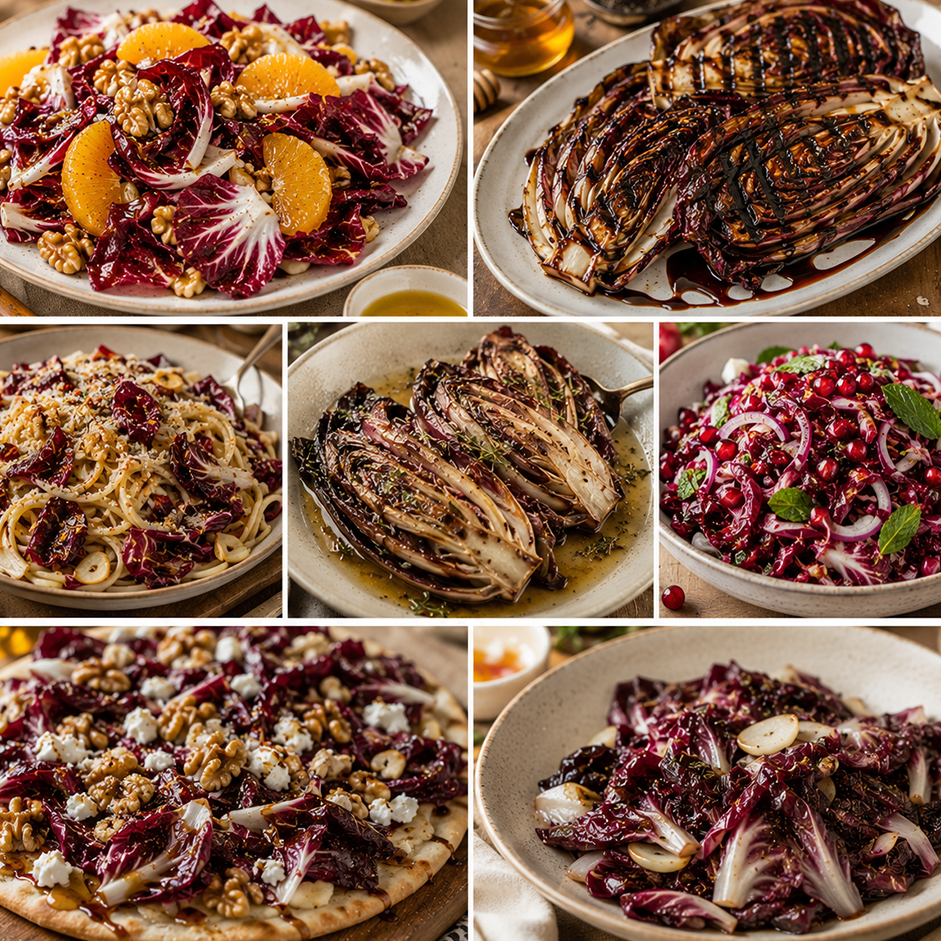
- Day 1 — The classic Italian radicchio salad: Separate heads into leaves. Tear into pieces. Dress with extra virgin olive oil, fresh orange juice, a splash of aged balsamic vinegar, sea salt, and cracked black pepper. Top with orange segments, toasted walnuts, and a drizzle of raw honey. This is the preparation that converts first-time bitter-leaf buyers — the orange and walnut completely reframe the bitterness as complexity.
- Day 2 — Grilled with balsamic glaze (the most transformative): Halve chicory heads lengthwise. Brush with olive oil. Place cut-face-down on a screaming hot grill pan. 3–4 minutes without touching — until charred and caramelised. Flip 2 minutes. Remove. Drizzle with aged balsamic and honey while still hot. Serve alongside steak, lamb, or as a standalone vegetable course. One of the most extraordinary things you can do with a vegetable in 8 minutes.
- Day 3 — Bitter leaf pasta: Tear leaves into strips. Add to drained al dente pasta with olive oil, garlic, chilli flakes, and a handful of toasted breadcrumbs. Toss over high heat 2 minutes. The bitterness becomes the seasoning — no salt needed beyond the pasta water.
- Day 4 — Braised chicory (for bitterness beginners): Halve heads. Brown cut-face-down in olive oil. Add a splash of white wine, a pinch of sugar, and salt. Cover and braise at 180°C for 20–25 minutes. All bitterness converts to sweetness. Serve with roasted chicken or fish.
- Day 5 — Raw slaw with pomegranate: Finely shred raw red chicory. Mix with pomegranate seeds, finely sliced red onion, fresh mint, and a dressing of olive oil, pomegranate molasses, and lemon. Vibrant, complex, UAE-relevant — the pomegranate molasses mirrors the balsamic principle of sweet-acid.
- Day 6 — Pizza or flatbread topping: Scatter raw leaves over a freshly baked pizza or grilled flatbread immediately out of the oven. The residual heat wilts the leaves. Top with walnuts, honey, and crumbled white cheese. A Venetian-Dutch restaurant classic adapted for the UAE kitchen.
- Day 7 — Wilted with garlic and olive oil: Any remaining leaves, wilted in a pan with olive oil, two sliced garlic cloves, a pinch of salt, and a splash of lemon juice. 2–3 minutes on high heat. A side dish that can accompany any protein and uses up the final quantity with zero waste.
HOW TO MANAGE THE BITTERNESS
For those encountering red chicory for the first time, bitterness management is a learnable skill rather than a matter of personal taste. Three techniques reliably reduce bitterness before eating: salt-and-rest (tear leaves, sprinkle with salt, leave 15 minutes, rinse lightly), cold water soak (submerge in cold water 15–30 minutes — reduces bitter compounds by approximately 20–30%), or any cooking method (grilling most, braising completely, wilting moderately). For dressing, the three principles — sweet, fat, acid — transform bitterness into complexity every time.
Reviews
Login
Don't have an account?
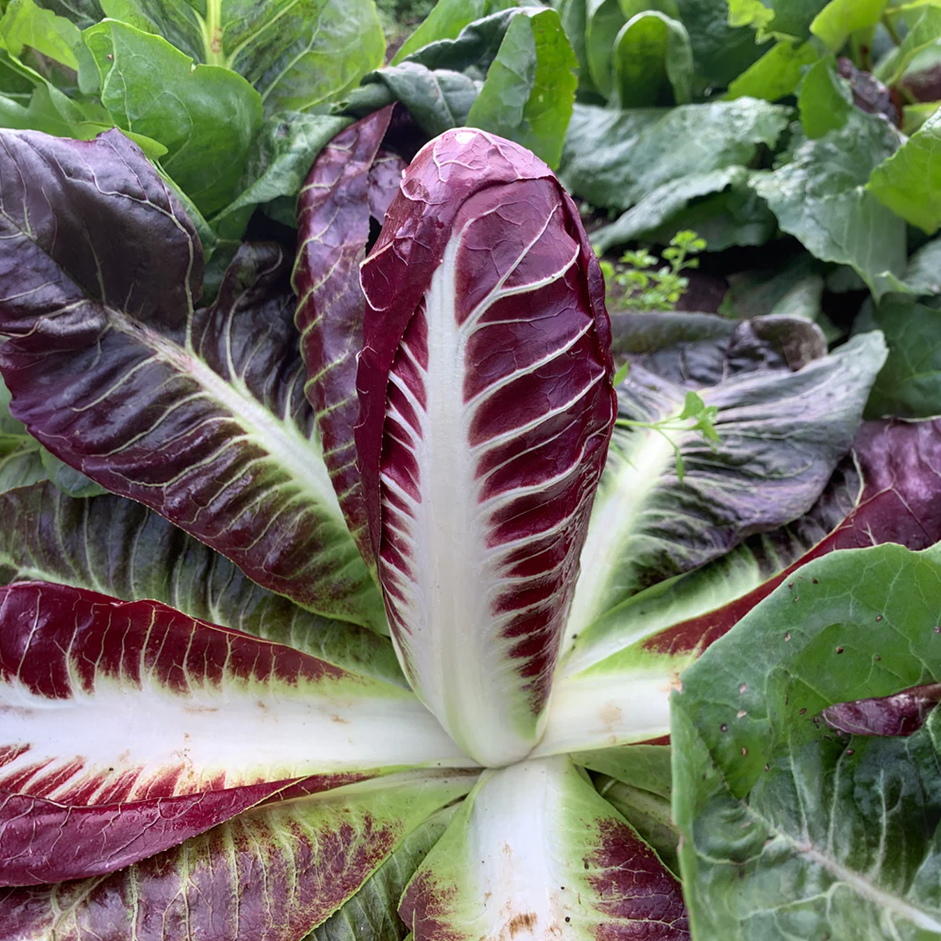
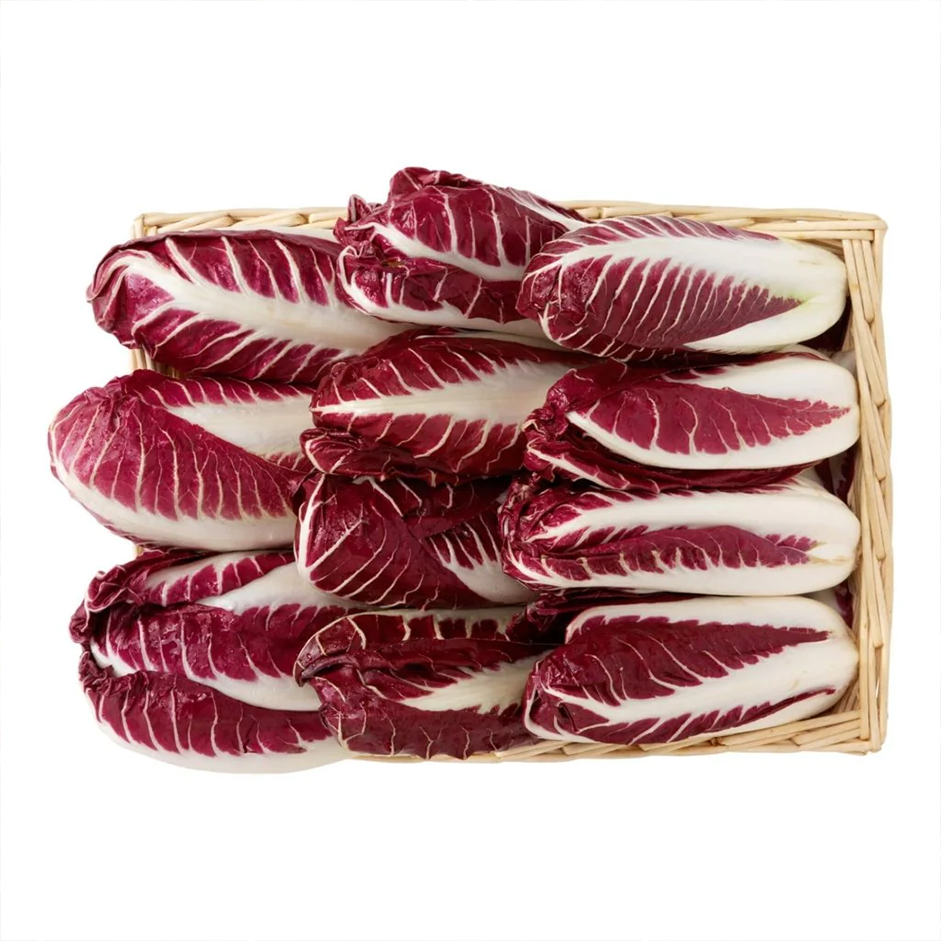
Sign UpRed chicory (Cichorium intybus) is a member of the daisy family (Asteraceae) and a close relative of endive, escarole, and radicchio. The variety most commonly sold as 'red chicory' in the European market includes: Radicchio (Italian varieties): Compact, round heads (Chioggia type) or elongated heads (Treviso type) with deep crimson-to-purple leaves marked by white ribs. The most visually dramatic salad leaf available. Grown across northern Italy and the Netherlands. Witloof Rosso (Dutch forced chicory): The Dutch development of the traditional witloof (white chicory) forcing technique applied to red varieties — grown in controlled darkness to develop pale yellow-to-red colouration, tight elongated heads, and precisely calibrated bitterness. The Netherlands is the world's largest producer of this style. Flavour profile: Pleasantly bitter is the essential description — and the word 'pleasantly' is doing important work. The bitterness of red chicory is different in character from the sharp bitterness of dark coffee or burnt food. It is rounded, earthy, and nutty — with a clean finish and a mild sweetness that emerges alongside the bitter notes, especially when the leaf is grilled or braised. The bitterness comes from lactucopicrin (a sesquiterpene lactone) and intybin compounds that are also the source of the vegetable's liver-protective and digestive properties. How to manage the bitterness: For raw preparations, pair with something sweet (orange segments, honey, pomegranate), something fatty (walnuts, olive oil, cheese), and something acidic (balsamic vinegar, lemon). These three elements — sweet, fat, acid — together transform the bitterness from confrontational to complex. For cooked preparations, high heat caramelises the outer leaves and converts some bitterness to sweetness — grilled red chicory with balsamic glaze is one of the most transformative cooking techniques available with any vegetable.
Red chicory (Cichorium intybus) is a member of the daisy family (Asteraceae) and a close relative of endive, escarole, and radicchio. The variety most commonly sold as 'red chicory' in the European market includes: |
Red chicory is the most clinically studied salad vegetable in European herbal medicine, with a documented history of therapeutic use spanning over 2,000 years. Modern nutritional science has validated the mechanisms behind most of the traditional uses.
Inulin — prebiotic powerhouse: Red chicory root is the primary commercial source of inulin — the prebiotic soluble fibre used in probiotic supplements, functional foods, and clinical gut health protocols. The leaves of red chicory contain meaningful quantities of inulin (approximately 0.8–1.2g per 100g of fresh leaf — the highest concentration among salad vegetables). Inulin is a fructooligosaccharide that feeds Bifidobacterium and Lactobacillus species in the colon, supporting microbiome diversity, improving bowel regularity, and producing short-chain fatty acids (SCFAs) that nourish the gut lining. Clinical studies show inulin supplementation consistently improves markers of gut microbiome health, increases beneficial bacterial populations, and reduces constipation.
Liver support — lactucopicrin and bitter compounds: The bitter sesquiterpene lactones in red chicory — particularly lactucopicrin and intybin — have been studied for their hepatoprotective (liver-protective) effects. These compounds stimulate bile production and bile flow (choleretic and cholagogue effects), supporting the liver's fat digestion and detoxification functions. Traditional European herbal medicine has used chicory root preparations specifically for liver congestion, sluggish digestion, and gallbladder support for centuries — and the mechanism (bitter compound → bile stimulation → improved liver fat metabolism) is well-established in modern hepatology.
Blood sugar management: Inulin in red chicory has a demonstrated effect on postprandial blood glucose — the same mechanism as guar fibre in gawar beans. The prebiotic fibre slows gastric emptying and carbohydrate absorption. Additionally, chicory's bitter compounds have been studied for improving insulin sensitivity in type 2 diabetic patients. Multiple clinical trials show regular chicory consumption reduces fasting blood glucose and HbA1c over 8–12 week periods.
Anthocyanins — cardiovascular and neuroprotective: The deep crimson colour of red chicory exceeds that of standard red lettuce in anthocyanin concentration, providing the same class of polyphenol antioxidants found in blueberries and red wine — studied for LDL oxidation reduction, arterial inflammation reduction, and neuroprotective effects.
Vitamin K: 297mcg per 100g — 248% of daily value. Among the highest Vitamin K concentrations in any leafy vegetable. Essential for bone mineralisation and cardiovascular protection.
Folate: 110mcg per 100g — 28% DV. Essential for DNA synthesis and pregnancy.
Copper: 0.28mg per 100g — 31% DV. Supports immune function, iron metabolism, and connective tissue synthesis — a micronutrient frequently deficient in UAE population studies. Red chicory is the most clinically studied salad vegetable in European herbal medicine, with a documented history of therapeutic use spanning over 2,000 years. Modern nutritional science has validated the mechanisms behind most of the traditional uses.
Inulin — prebiotic powerhouse: Red chicory root is the primary commercial source of inulin — the prebiotic soluble fibre used in probiotic supplements, functional foods, and clinical gut health protocols. The leaves of red chicory contain meaningful quantities of inulin (approximately 0.8–1.2g per 100g of fresh leaf — the highest concentration among salad vegetables). Inulin is a fructooligosaccharide that feeds Bifidobacterium and Lactobacillus species in the colon, supporting microbiome diversity, improving bowel regularity, and producing short-chain fatty acids (SCFAs) that nourish the gut lining. Clinical studies show inulin supplementation consistently improves markers of gut microbiome health, increases beneficial bacterial populations, and reduces constipation.
Liver support — lactucopicrin and bitter compounds: The bitter sesquiterpene lactones in red chicory — particularly lactucopicrin and intybin — have been studied for their hepatoprotective (liver-protective) effects. These compounds stimulate bile production and bile flow (choleretic and cholagogue effects), supporting the liver's fat digestion and detoxification functions. Traditional European herbal medicine has used chicory root preparations specifically for liver congestion, sluggish digestion, and gallbladder support for centuries — and the mechanism (bitter compound → bile stimulation → improved liver fat metabolism) is well-established in modern hepatology.
Blood sugar management: Inulin in red chicory has a demonstrated effect on postprandial blood glucose — the same mechanism as guar fibre in gawar beans. The prebiotic fibre slows gastric emptying and carbohydrate absorption. Additionally, chicory's bitter compounds have been studied for improving insulin sensitivity in type 2 diabetic patients. Multiple clinical trials show regular chicory consumption reduces fasting blood glucose and HbA1c over 8–12 week periods.
Anthocyanins — cardiovascular and neuroprotective: The deep crimson colour of red chicory exceeds that of standard red lettuce in anthocyanin concentration, providing the same class of polyphenol antioxidants found in blueberries and red wine — studied for LDL oxidation reduction, arterial inflammation reduction, and neuroprotective effects.
Vitamin K: 297mcg per 100g — 248% of daily value. Among the highest Vitamin K concentrations in any leafy vegetable. Essential for bone mineralisation and cardiovascular protection.
Folate: 110mcg per 100g — 28% DV. Essential for DNA synthesis and pregnancy.
Copper: 0.28mg per 100g — 31% DV. Supports immune function, iron metabolism, and connective tissue synthesis — a micronutrient frequently deficient in UAE population studies.
Red chicory is one of the most versatile salad vegetables in European cuisine, genuinely improving with cooking in ways that most salad leaves do not.
Raw — the classic Italian-Dutch salad: Separate leaves from a head of red chicory. Tear or keep whole. The essential dressing for raw red chicory is: extra virgin olive oil + fresh orange juice (not lemon — the orange sweetness balances the bitterness better) + a splash of good balsamic vinegar + sea salt + cracked black pepper. Top with orange segments, toasted walnuts, and a drizzle of raw honey. This combination — bitter leaf, sweet orange, fatty walnut, acidic balsamic — is not accidental. It has been refined over centuries of Italian and Dutch winter salad cuisine because sweet, fat, and acid are the three elements that transform bitterness from confrontational to complex.
Grilled red chicory (the most transformative preparation): Halve heads lengthwise. Brush cut faces with extra virgin olive oil and a pinch of salt. Place cut-face-down on a hot grill pan or BBQ over high heat. Grill 3–4 minutes without moving — until the cut face is charred, caramelised, and deeply browned. Flip and grill the rounded side 2 minutes. Remove. Drizzle with aged balsamic vinegar and honey while still hot. The high heat caramelises the outer leaves, converts some bitterness to sweetness, and creates a smoky depth that makes grilled red chicory one of the most extraordinary side dishes in European cuisine. Serve alongside grilled steak, lamb chops, or roasted chicken.
Braised red chicory (Italian-style): In a wide oven-safe pan, heat olive oil. Add halved chicory heads cut-face-down. Brown 3 minutes. Add a splash of white wine or vegetable stock, a pinch of sugar, and salt. Cover and braise in the oven at 180°C for 20–25 minutes until completely tender and the liquid has reduced to a glaze. The braising converts almost all of the bitterness to sweetness — this preparation is for those who find raw chicory too intense.
Pasta and risotto: Tear leaves into strips. Add to pasta in the final 2 minutes of cooking — the heat wilts them and they absorb the pasta water and fat. Add to risotto in the last 5 minutes. The bitterness adds complexity to rich, fatty preparations in the way that a squeeze of lemon would — it balances rather than dominates.
Pizza topping: Scatter raw leaves over a freshly cooked pizza base immediately out of the oven. The residual heat wilts the leaves gently. Top with walnuts and honey. A Venetian and Dutch restaurant classic. Red chicory is one of the most versatile salad vegetables in European cuisine, genuinely improving with cooking in ways that most salad leaves do not.
Raw — the classic Italian-Dutch salad: Separate leaves from a head of red chicory. Tear or keep whole. The essential dressing for raw red chicory is: extra virgin olive oil + fresh orange juice (not lemon — the orange sweetness balances the bitterness better) + a splash of good balsamic vinegar + sea salt + cracked black pepper. Top with orange segments, toasted walnuts, and a drizzle of raw honey. This combination — bitter leaf, sweet orange, fatty walnut, acidic balsamic — is not accidental. It has been refined over centuries of Italian and Dutch winter salad cuisine because sweet, fat, and acid are the three elements that transform bitterness from confrontational to complex.
Grilled red chicory (the most transformative preparation): Halve heads lengthwise. Brush cut faces with extra virgin olive oil and a pinch of salt. Place cut-face-down on a hot grill pan or BBQ over high heat. Grill 3–4 minutes without moving — until the cut face is charred, caramelised, and deeply browned. Flip and grill the rounded side 2 minutes. Remove. Drizzle with aged balsamic vinegar and honey while still hot. The high heat caramelises the outer leaves, converts some bitterness to sweetness, and creates a smoky depth that makes grilled red chicory one of the most extraordinary side dishes in European cuisine. Serve alongside grilled steak, lamb chops, or roasted chicken.
Braised red chicory (Italian-style): In a wide oven-safe pan, heat olive oil. Add halved chicory heads cut-face-down. Brown 3 minutes. Add a splash of white wine or vegetable stock, a pinch of sugar, and salt. Cover and braise in the oven at 180°C for 20–25 minutes until completely tender and the liquid has reduced to a glaze. The braising converts almost all of the bitterness to sweetness — this preparation is for those who find raw chicory too intense.
Pasta and risotto: Tear leaves into strips. Add to pasta in the final 2 minutes of cooking — the heat wilts them and they absorb the pasta water and fat. Add to risotto in the last 5 minutes. The bitterness adds complexity to rich, fatty preparations in the way that a squeeze of lemon would — it balances rather than dominates.
Pizza topping: Scatter raw leaves over a freshly cooked pizza base immediately out of the oven. The residual heat wilts the leaves gently. Top with walnuts and honey. A Venetian and Dutch restaurant classic.
The Netherlands is the world's largest producer and exporter of chicory, and Dutch forced chicory is the global quality benchmark for a specific reason: the forcing technique that Dutch growers have perfected over 200 years produces a more precisely calibrated, more consistent, and more nutritionally dense product than field-grown equivalents.
What forcing means: Chicory is a biennial plant — in its first year, it develops a large taproot. Traditional field-grown chicory produces loose, open leaves that are often intensely and unpredictably bitter. The Dutch forcing technique harvests the roots after the first growing season, then forces them in controlled indoor conditions — total darkness or minimal light, controlled temperature (10–15°C), and high humidity — over a period of 3–4 weeks. In these conditions, the plant draws on the energy stored in the root to produce a tight, compact head of new leaves that are more tender, more evenly coloured, more precisely bitter, and more nutritionally concentrated than field-grown leaves.
Why darkness produces the colour: In standard field conditions, chicory produces green chlorophyll leaves. In the dark or near-dark of forced growing, chlorophyll cannot develop — instead, the leaves develop anthocyanins (red-purple pigments) as the plant's stress response to light deprivation. This is the counterintuitive mechanism: the darkness that gives Dutch red chicory its extraordinary crimson colour is the same darkness that concentrates the anthocyanin antioxidants.
Dutch precision: Dutch chicory producers use computer-controlled growing facilities that regulate temperature, humidity, CO2 levels, and light exposure to within narrow tolerances. The result is a product with a consistent flavour profile, colour intensity, and nutritional profile across every delivery — a quality consistency that field-grown varieties from less controlled production systems cannot match.
Nutritional concentration: Because the plant is drawing on root energy reserves rather than photosynthesis, forced chicory leaves contain higher concentrations of inulin, bitter sesquiterpene lactones, and micronutrients per gram than field-grown equivalents. The compact, dense head structure also means less water dilution of the nutrient content compared to loose-leaf field varieties. The Netherlands is the world's largest producer and exporter of chicory, and Dutch forced chicory is the global quality benchmark for a specific reason: the forcing technique that Dutch growers have perfected over 200 years produces a more precisely calibrated, more consistent, and more nutritionally dense product than field-grown equivalents.
What forcing means: Chicory is a biennial plant — in its first year, it develops a large taproot. Traditional field-grown chicory produces loose, open leaves that are often intensely and unpredictably bitter. The Dutch forcing technique harvests the roots after the first growing season, then forces them in controlled indoor conditions — total darkness or minimal light, controlled temperature (10–15°C), and high humidity — over a period of 3–4 weeks. In these conditions, the plant draws on the energy stored in the root to produce a tight, compact head of new leaves that are more tender, more evenly coloured, more precisely bitter, and more nutritionally concentrated than field-grown leaves.
Why darkness produces the colour: In standard field conditions, chicory produces green chlorophyll leaves. In the dark or near-dark of forced growing, chlorophyll cannot develop — instead, the leaves develop anthocyanins (red-purple pigments) as the plant's stress response to light deprivation. This is the counterintuitive mechanism: the darkness that gives Dutch red chicory its extraordinary crimson colour is the same darkness that concentrates the anthocyanin antioxidants.
Dutch precision: Dutch chicory producers use computer-controlled growing facilities that regulate temperature, humidity, CO2 levels, and light exposure to within narrow tolerances. The result is a product with a consistent flavour profile, colour intensity, and nutritional profile across every delivery — a quality consistency that field-grown varieties from less controlled production systems cannot match.
Nutritional concentration: Because the plant is drawing on root energy reserves rather than photosynthesis, forced chicory leaves contain higher concentrations of inulin, bitter sesquiterpene lactones, and micronutrients per gram than field-grown equivalents. The compact, dense head structure also means less water dilution of the nutrient content compared to loose-leaf field varieties.
Storing red chicory: Red chicory heads are considerably more robust than loose salad leaves and will keep well for 7–10 days with correct storage. The tight, compact head structure protects the inner leaves from moisture loss and oxidation.
Uncut heads: Store in the crisper drawer of the refrigerator, loosely wrapped in a paper towel or placed in a paper bag. Do not store in a sealed plastic bag — the trapped moisture softens the outer leaves. Keep away from ethylene-producing fruits (apples, bananas, tomatoes) which accelerate leaf yellowing. Uncut heads will keep for 7–10 days.
Once cut: Tightly wrap the cut face with beeswax wrap or cling film and refrigerate. Use within 3–4 days. The cut face oxidises and the leaves begin to separate — use the inner leaves first.
For a 1kg quantity: Red chicory is more robust than loose lettuce and genuinely improves with different preparations across the week. Day 1–2: raw salad with orange and walnut (the bitterest and most nutritious preparation). Day 3–4: grilled with balsamic and honey (the flavour complexity increases as the heads mature slightly). Day 5–6: braised or added to pasta and risotto (the longest-cooked preparation, works even with heads that have softened slightly). Day 7: wilt remaining leaves in olive oil and garlic and serve as a side — like spinach but with significantly more nutritional complexity.
Managing bitterness — a guide for first-time buyers: The bitterness of red chicory is adjustable, not fixed. These techniques reduce it:
Salt and rest: Tear leaves, sprinkle with sea salt, and leave for 10–15 minutes. The salt draws out some of the bitter compounds with the moisture. Rinse lightly and dress.
Soak in cold water: Submerge whole leaves or torn pieces in cold water for 15–30 minutes. This leaches out some lactucopicrin and reduces bitterness by approximately 20–30% without significantly reducing nutritional content.
Heat: Any cooking application reduces bitterness significantly. Grilling reduces it the most dramatically (caramelisation). Braising converts almost all bitterness to sweetness. Wilting in olive oil reduces it moderately.
Pairing: Orange (sweet acid), honey (concentrated sweetness), walnuts (fat and earthiness), balsamic vinegar (sweet acid), aged cheese (fat and salt) — any combination of these three principles (sweet, fat, acid) around the bitter leaf makes the bitterness a positive complexity rather than a challenge. Storing red chicory: Red chicory heads are considerably more robust than loose salad leaves and will keep well for 7–10 days with correct storage. The tight, compact head structure protects the inner leaves from moisture loss and oxidation.
Uncut heads: Store in the crisper drawer of the refrigerator, loosely wrapped in a paper towel or placed in a paper bag. Do not store in a sealed plastic bag — the trapped moisture softens the outer leaves. Keep away from ethylene-producing fruits (apples, bananas, tomatoes) which accelerate leaf yellowing. Uncut heads will keep for 7–10 days.
Once cut: Tightly wrap the cut face with beeswax wrap or cling film and refrigerate. Use within 3–4 days. The cut face oxidises and the leaves begin to separate — use the inner leaves first.
For a 1kg quantity: Red chicory is more robust than loose lettuce and genuinely improves with different preparations across the week. Day 1–2: raw salad with orange and walnut (the bitterest and most nutritious preparation). Day 3–4: grilled with balsamic and honey (the flavour complexity increases as the heads mature slightly). Day 5–6: braised or added to pasta and risotto (the longest-cooked preparation, works even with heads that have softened slightly). Day 7: wilt remaining leaves in olive oil and garlic and serve as a side — like spinach but with significantly more nutritional complexity.
Managing bitterness — a guide for first-time buyers: The bitterness of red chicory is adjustable, not fixed. These techniques reduce it:
Salt and rest: Tear leaves, sprinkle with sea salt, and leave for 10–15 minutes. The salt draws out some of the bitter compounds with the moisture. Rinse lightly and dress.
Soak in cold water: Submerge whole leaves or torn pieces in cold water for 15–30 minutes. This leaches out some lactucopicrin and reduces bitterness by approximately 20–30% without significantly reducing nutritional content.
Heat: Any cooking application reduces bitterness significantly. Grilling reduces it the most dramatically (caramelisation). Braising converts almost all bitterness to sweetness. Wilting in olive oil reduces it moderately.
Pairing: Orange (sweet acid), honey (concentrated sweetness), walnuts (fat and earthiness), balsamic vinegar (sweet acid), aged cheese (fat and salt) — any combination of these three principles (sweet, fat, acid) around the bitter leaf makes the bitterness a positive complexity rather than a challenge.


