
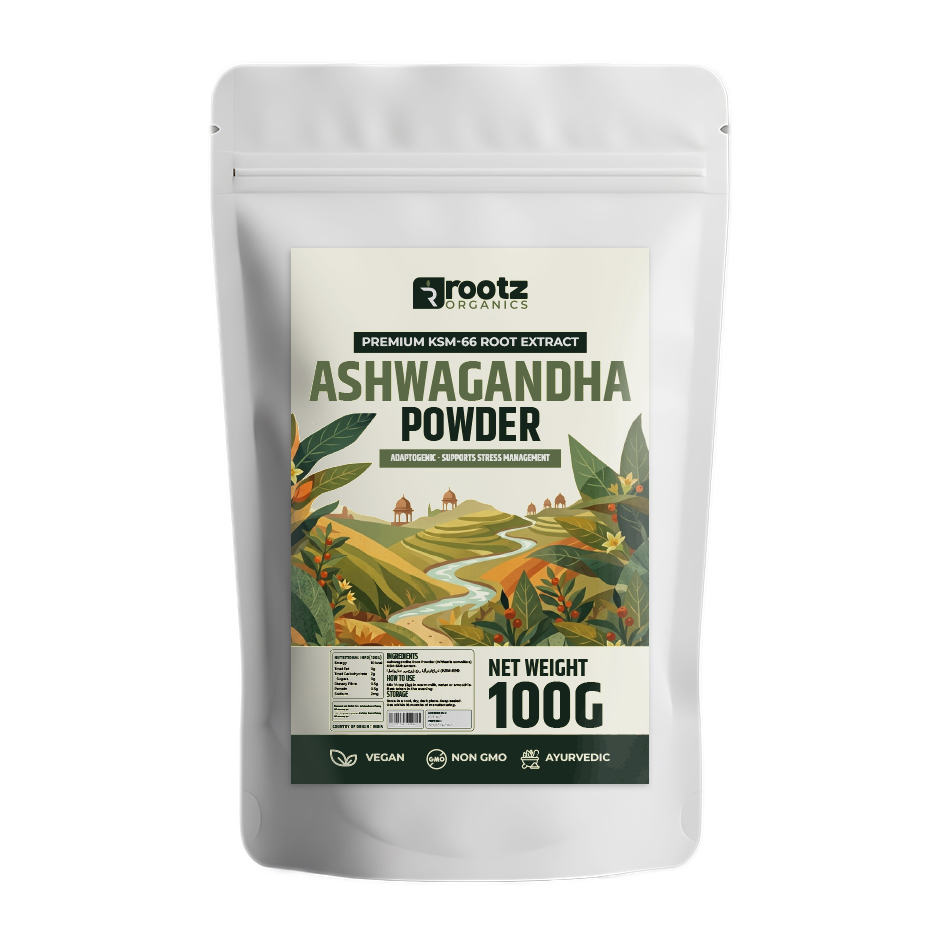
Product description
In Ayurveda, ashwagandha is classified as a rasayana — a class of herbs used to support longevity, vitality, and the body's capacity to adapt to physical and mental demands. It has been prescribed in traditional medicine for thousands of years, across generations of practitioners, for one consistent reason: it works.
Modern research has now studied it extensively — and the results validate what Ayurveda always knew. The active compounds, called withanolides, are found primarily in the root. Our Ashwagandha Powder uses KSM-66® — a full-spectrum root extract developed by Ixoreal Biomed that is the most clinically studied ashwagandha extract in the world, with over 24 gold-standard clinical trials behind it.
WHAT KSM-66® MEANS AND WHY IT MATTERS
Most ashwagandha supplements are made from a mix of root and leaf — or leaf alone — because it is cheaper. KSM-66® uses only the root, extracted using a proprietary process that preserves the full-spectrum withanolide profile without using alcohol or chemical solvents. This matters because the root is where the functional compounds are concentrated. Leaf-based extracts have a significantly lower withanolide content and a different phytochemical profile.
HOW ASHWAGANDHA IS TRADITIONALLY USED
Morning ritual: Mix ½ teaspoon in warm A2 milk with a little raw honey. Drink 30 minutes before breakfast.
Evening ritual: The same preparation taken before bed is a traditional Ayurvedic approach to supporting restful sleep and recovery.
In smoothies: Add ½ teaspoon to a banana, almond milk, and date smoothie. The slightly earthy, bitter flavour blends well with sweetness.
In golden milk: Combine with turmeric, black pepper, coconut oil, and warm milk for a complete adaptogenic drink.
Recommended daily amount: ½ teaspoon (approximately 2g) per day. Begin with a smaller amount and increase gradually.
WHO IT IS FOR
Ashwagandha is traditionally valued in Ayurveda for individuals experiencing periods of elevated physical or mental demand — whether from work, training, life transitions, or seasonal change. It is commonly used in modern wellness routines for energy balance, recovery support, and overall vitality.
It is not a sedative, not a stimulant, and not a pharmaceutical. It is an adaptogen — a class of botanicals that work with your body's own systems rather than overriding them.
INGREDIENTS
KSM-66® Ashwagandha Root Extract (Withania somnifera). No fillers. No additives. No preservatives. Vegan.
| Nutrient | Value | % Daily Value |
|---|---|---|
Energy 245 kcal | 245 kcal | --- |
| Saturated Fat | 0.5g | 0 % |
Total sugars | 0g | 0 % |
Sodium | 65mg | 0% |
| Total Carbohydrate | 40g | 0% |
| Dietary Fiber | 16g | 1% |
Iron | 15mg | 2% |
Calcium | 320mg | 1% |
Withanolides (active compound) | Min. 5% | -- |
STORAGE
Store in a cool, dry, dark place. Keep sealed after opening — ashwagandha is sensitive to heat and moisture. Consume within 12 months of manufacture date printed on pack.
Reviews
Login
Don't have an account?
Sign UpKSM-66® is a proprietary full-spectrum ashwagandha root extract developed by Ixoreal Biomed. It is extracted from the root only — never the leaf — using a process that preserves the complete natural profile of withanolides (the active compounds) without the use of alcohol or synthetic chemical solvents. It is the most clinically studied ashwagandha extract available, with over 24 published clinical trials examining its effects on various aspects of wellness. When you see KSM-66® on a supplement, it means the withanolide content is verified, the extraction is clean, and the research behind it is real.
KSM-66® is a proprietary full-spectrum ashwagandha root extract developed by Ixoreal Biomed. It is extracted from the root only — never the leaf — using a process that preserves the complete natural profile of withanolides (the active compounds) without the use of alcohol or synthetic chemical solvents. It is the most clinically studied ashwagandha extract available, with over 24 published clinical trials examining its effects on various aspects of wellness. When you see KSM-66® on a supplement, it means the withanolide content is verified, the extraction is clean, and the research behind it is real.
Traditionally in Ayurveda, ashwagandha is taken twice daily — once in the morning and once before bed, mixed in warm milk with honey. For most people, an evening serving is the most popular starting point: ½ teaspoon in warm A2 milk 30–60 minutes before sleep. Morning use is preferred by those who use it for energy and daily vitality support. It can also be added to smoothies, golden milk, or herbal drinks. Start with a smaller amount (¼ teaspoon) for the first week and increase gradually.
Traditionally in Ayurveda, ashwagandha is taken twice daily — once in the morning and once before bed, mixed in warm milk with honey. For most people, an evening serving is the most popular starting point: ½ teaspoon in warm A2 milk 30–60 minutes before sleep. Morning use is preferred by those who use it for energy and daily vitality support. It can also be added to smoothies, golden milk, or herbal drinks. Start with a smaller amount (¼ teaspoon) for the first week and increase gradually.
Ashwagandha is not a fast-acting supplement like caffeine. It works through gradual systemic support. Most people report noticing a difference in overall sense of wellbeing, sleep quality, and energy balance within 4–8 weeks of consistent daily use. Clinical studies typically measure outcomes at 8–12 weeks. Consistency matters more than dosage — a small daily amount taken regularly will produce better results than a large occasional dose.
Ashwagandha is not a fast-acting supplement like caffeine. It works through gradual systemic support. Most people report noticing a difference in overall sense of wellbeing, sleep quality, and energy balance within 4–8 weeks of consistent daily use. Clinical studies typically measure outcomes at 8–12 weeks. Consistency matters more than dosage — a small daily amount taken regularly will produce better results than a large occasional dose.
Ashwagandha is not recommended during pregnancy or breastfeeding. If you are taking prescription medication — particularly thyroid, immunosuppressant, or sedative medications — consult your healthcare provider before beginning ashwagandha supplementation, as it may interact with certain drug classes. For healthy adults not on medication, ashwagandha has a strong safety record at the standard dosage of 2–5g per day. As with any supplement, introduce it gradually and stop use if you experience any adverse reaction.
Ashwagandha is not recommended during pregnancy or breastfeeding. If you are taking prescription medication — particularly thyroid, immunosuppressant, or sedative medications — consult your healthcare provider before beginning ashwagandha supplementation, as it may interact with certain drug classes. For healthy adults not on medication, ashwagandha has a strong safety record at the standard dosage of 2–5g per day. As with any supplement, introduce it gradually and stop use if you experience any adverse reaction.


