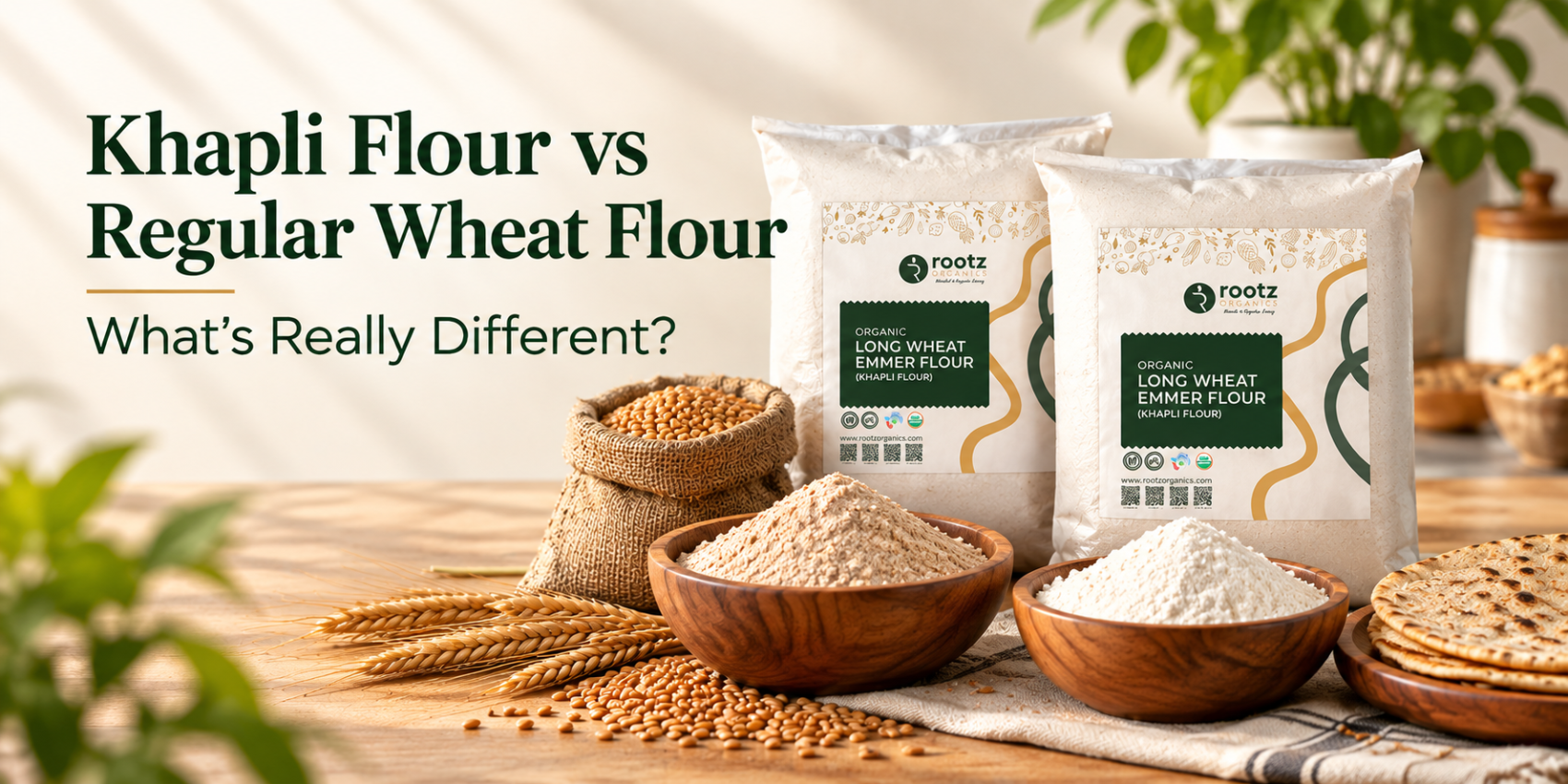
Khapli Flour vs Regular Wheat Flour: What’s Really Different?
Walk into any UAE kitchen, and you'll likely find a bag of wheat flour close at hand. Roti, paratha, naan, and khubz all begin with this one humble ingredient. But over the last few years, an ancient grain has been steadily making its way back onto Emirati and expat tables: Khapli wheat also known as Emmer Flour. As more households across Dubai, Abu Dhabi, and Sharjah look for cleaner, more nourishing pantry staples, the comparison between Khapli (Emmer) Flour and regular wheat flour has become one of the most common questions we hear at Rootz Organics.
So, what actually sets these two apart? Let's break it down in simple, practical terms — from grain origin to nutrition, texture, and everyday use.
What is Khapli (Emmer) Flour?
Khapli wheat, scientifically known as Emmer wheat (Triticum dicoccum), is one of the oldest cultivated wheat varieties in the world, with roots tracing back thousands of years to the Indian subcontinent. Unlike modern hybrid wheat, Khapli (Emmer) has remained largely unchanged by intensive breeding programs, which is part of why it's often described as an "ancient grain."
Flour milled from this grain, known as Khapli Wheat Flour, has a distinct reddish-brown hue, a slightly nutty aroma, and a denser bite compared to what most people are used to. It's also naturally lower in gluten content, which is one of the primary reasons it has become popular among people looking for gut-friendly alternatives to conventional wheat.
What is Regular Wheat Flour?
Regular wheat flour typically comes from common wheat, or Triticum aestivum, the most widely cultivated wheat species globally. Over decades, this variety has been selectively bred to improve yield, gluten strength, and milling efficiency, making it the standard choice for large-scale bread, bakery, and flatbread production.
This flour is soft, easy to knead, and produces the light, fluffy texture most people associate with rotis, parathas, and baked goods. It's a familiar, versatile staple that has anchored kitchens for generations, and for many households, it remains a dependable everyday choice.
Khapli (Emmer) Flour vs Regular Wheat Flour: Quick Comparison Table
For readers who want a quick, at-a-glance summary, here's how the two flours compare across the factors that matter most:
| Parameter | Khapli Flour (Emmer Wheat) | Regular Wheat Flour |
|---|---|---|
| Botanical Name | Triticum dicoccum | Triticum aestivum |
| Grain Type | Ancient, minimally hybridised grain | Modern, selectively bred grain |
| Gluten Content | Naturally lower, easier to digest | Higher, gives strong elasticity |
| Fibre Content | Rich in dietary fibre | Moderate fibre content |
| Protein Profile | Good amino acid balance | Reliable, consistent protein source |
| Key Minerals | Notable magnesium, zinc, and iron | Contains B-vitamins and iron |
| Texture (Dough) | Slightly dense, needs more kneading | Soft, smooth, easy to roll |
| Taste | Earthy, subtly nutty flavour | Mild, neutral flavour |
| Best Suited For | Daily rotis, health-focused meals | Parathas, breads, layered flatbreads |
| Processing Level | Closer to its natural form | Refined for consistency and yield |
| Popular Among | Gut-conscious, wellness-focused households | Households seeking soft, familiar texture |
Nutritional Differences: A Side-by-Side Look
While both flours come from the wheat family, their nutrient profiles diverge in a few meaningful ways.
- Fibre content: Khapli (Emmer) wheat generally retains a higher fibre content, particularly when milled as a wholegrain flour, which supports digestion and helps maintain steady energy levels through the day.
- Protein and amino acids: Emmer wheat is known for a favourable amino acid profile and consistent protein content, making it a wholesome addition to a balanced diet.
- Micronutrients: Khapli wheat tends to carry a good concentration of minerals such as magnesium, zinc, and iron, largely because the grain hasn't undergone the same level of refinement as modern wheat varieties.
- Gluten structure: This is perhaps the most talked-about difference. Khapli wheat contains a different, and generally lower, gluten structure compared to regular wheat, which is why many people find it easier to digest, even though it is not a gluten-free grain.
Regular wheat flour is by no means nutritionally poor. It offers a solid source of carbohydrates, moderate protein, and B-vitamins, and continues to be a reliable staple for millions of households.
Taste, Texture, and Cooking Experience
If you've cooked with both, you'll notice the difference immediately. Khapli flour produces a slightly denser, earthier roti with a subtly nutty flavour, and the dough may need a touch more water and kneading time due to its fibre content. Many people who switch to it describe the taste as more "wholesome" and satisfying.
Regular wheat flour, on the other hand, is prized for its soft, pliable dough that's easy to roll out thin, making it ideal for light, fluffy rotis, layered parathas, and baked items like bread and buns.
Neither is objectively "better" in the kitchen — it largely comes down to the texture and flavour a household is used to, and what a particular recipe calls for.
Why More UAE Households Are Exploring Khapli Wheat Flour
The UAE's food culture is wonderfully diverse, with families from South Asia, the Middle East, and beyond sharing similar values around health-conscious eating. As awareness grows around gut health, mindful eating, and reducing processed ingredients in daily meals, Khapli wheat has found a natural place in many kitchens as a way to reconnect with more traditional, minimally processed grains.
At the same time, regular wheat flour continues to hold its place as a trusted, everyday essential — light, versatile, and familiar to generations of home cooks.
Choosing the Right Flour for Your Kitchen
There's no single "correct" flour for every household. Some families prefer to keep both varieties in their pantry, using Khapli flour for daily rotis and regular wheat flour for specific recipes that call for a softer dough or a particular texture.
When shopping for either option, it helps to pay attention to how the grain was grown and milled. Choosing Organic Wheat Flour — whether it's the ancient Khapli variety or common wheat — means the grain has been cultivated without synthetic pesticides or chemical fertilisers, and typically retains more of its natural nutrient content through minimal processing.
For those in the UAE looking to explore both options conveniently, Rootz Organics offers a curated range through Organic Flours Online, sourced with care and delivered fresh across the Emirates.
Which One Should You Choose?
Khapli flour and regular wheat flour each bring their own strengths to the table — one rooted in ancient tradition and dense nutrition, the other in familiar softness and everyday versatility. Understanding these differences empowers you to make an informed choice based on your family's taste preferences, dietary goals, and cooking style.
Whichever you choose, opting for clean, organically grown flour is a simple, meaningful step toward a healthier kitchen — one roti at a time.
Explore Rootz Organics' range of Khapli and organic wheat flours, thoughtfully sourced and delivered fresh across the UAE.
-
Psyllium Husk and Whole Seeds: The Simple Fibre Upgrade Every UAE Kitchen Needs
September 11th, 2026 -
 August 14th, 2026
 -
 August 14th, 2026