
Product description
FOUL MEDAMES: A DISH WITH A DOCUMENTED HISTORY
Foul medames (فول مدمّس) is a stew of stewed fava beans, typically finished with olive oil, lemon juice, cumin, and garlic. Its name blends Arabic ("foul" — beans) with Coptic ("medames" — buried), referring to the traditional method of slow-cooking a sealed pot of beans overnight, buried under hot coals — a technique referenced in the Jerusalem Talmud, indicating use across the Middle East since at least the 4th century CE. Widely regarded as Egypt’s national dish, foul medames is also a daily staple across Sudan and the wider Levant, most often eaten for breakfast with warm flatbread.
AN IMPORTANT NOTE: G6PD DEFICIENCY (FAVISM)
Fava beans contain natural compounds (vicine and convicine) that can trigger a serious reaction called favism — acute hemolytic anemia — in people with an inherited enzyme condition called G6PD deficiency. This condition is significantly more common in people of Mediterranean, Middle Eastern, African, and South or Southeast Asian descent, and most often affects young children. If you or a family member has G6PD deficiency, fava beans (including in falafel made with fava beans) should be avoided entirely. If you’re unsure whether this applies to your family, this is worth checking with a doctor before cooking with this product, particularly for young children.
PROTEIN AND FIBRE DENSITY
Raw dried fava beans provide approximately 26g of protein and 25g of dietary fibre per 100g — the highest fibre content of any pulse in the Rootz range, at close to 90% of a full day’s fibre value in a single 100g serving (USDA FoodData Central). They’re also a strong source of folate, magnesium, and copper.
HOW TO USE
- Rinse thoroughly, then soak for 8–12 hours or overnight
- Drain and simmer in fresh water for 60–90 minutes, until tender
- Foul medames: mash the cooked beans lightly, then finish with olive oil, lemon juice, cumin, and garlic
- Falafel: blend soaked (uncooked) fava beans with herbs, garlic, and spices, then shape and fry
- Serve with warm flatbread, chopped tomato, parsley, and a boiled egg, in the traditional style
STORAGE
Store in a cool, dry place in an airtight container, away from moisture and direct sunlight. Best used within 6–12 months of purchase.
Nutrient Per 100g (raw) % Daily Value* Energy 333 kcal 17% Total Fat ~1.0g 1% Total Carbohydrate 60.3g 22% Dietary Fibre 15.3g 55% Protein 23.4g 47% Iron 10.4mg 58% Magnesium 190mg 45% Potassium 1795mg 38% Folate (B9) 388mcg 97%
Reviews
Login
Don't have an account?
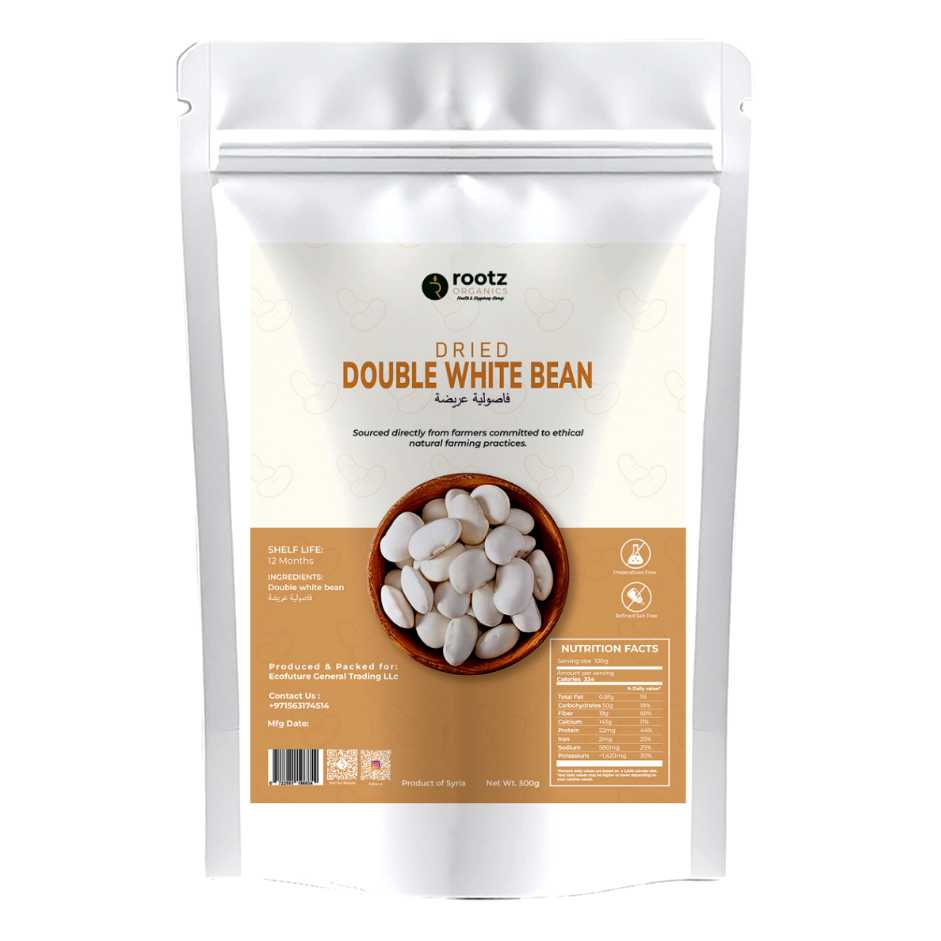
Sign UpThis is a larger, creamier white bean suited to slow-simmered stews and casseroles where you want the bean to hold its shape and structure. Our Organic Syrian White Beans (loubia bayda) is a different, smaller variety specifically used in Syrian fasolia. If you’re making fasolia, choose that one by name; for stews, casseroles, and hearty soups generally, this is the bean to use.
Soak for 6–8 hours or overnight, then simmer in fresh water for 45–60 minutes until tender. It’s particularly well-suited to slow-simmered stews and casseroles, where its ability to hold its shape through a long cook is the main advantage.
A 100g raw serving provides approximately 23g of protein and 15g of dietary fibre — over half a day’s fibre value in a single serving (USDA FoodData Central, generic white bean reference values).


