
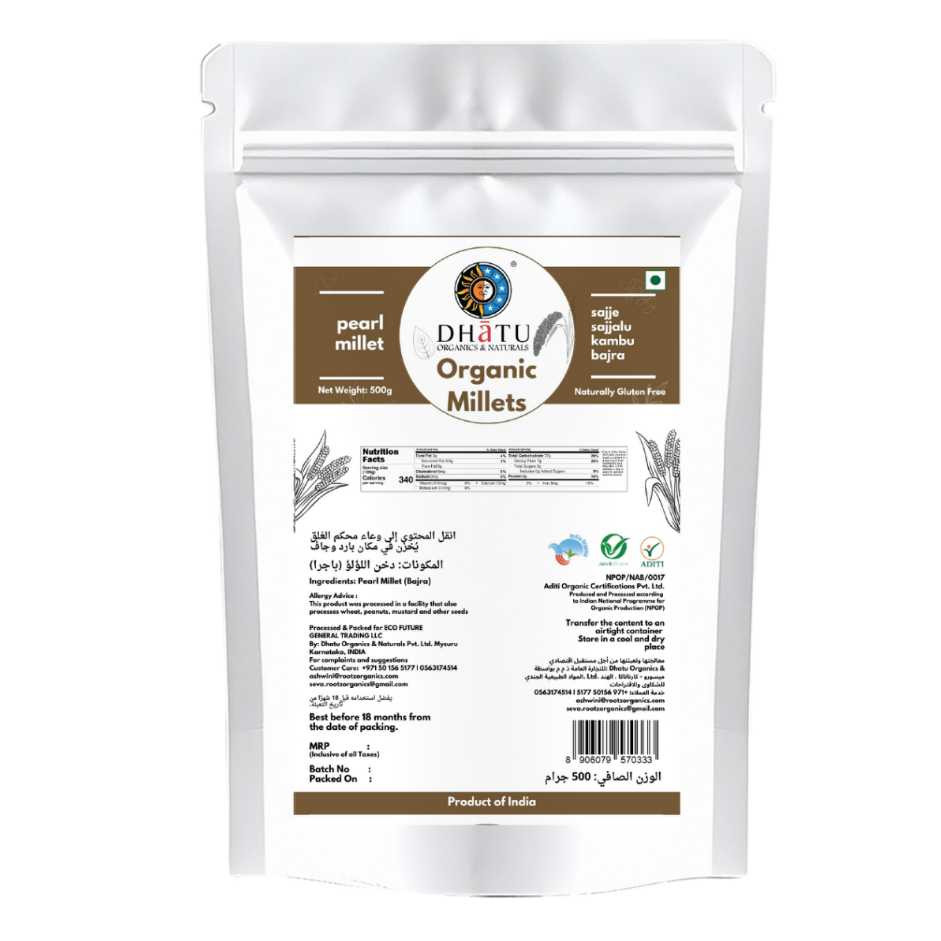
Product description
THE MOST WIDELY GROWN MILLET ON EARTH
Pearl millet (Pennisetum glaucum) accounts for approximately 50% of total global millet production and is grown across the arid and semi-arid regions of Africa and Asia. Originally domesticated in the Sahel region of West Africa approximately 4,000 years ago, it spread eastward to become a staple grain across India, particularly in Rajasthan, Gujarat, Maharashtra, Haryana, and Uttar Pradesh. In the UAE and Gulf region, pearl millet (known in Arabic as لؤلؤ or دخن) has its own longstanding culinary tradition in traditional flatbreads and regional preparations, making it the millet with the broadest cross-cultural recognition of any in the Rootz range.
APPROXIMATELY 8mg IRON PER 100g — THE HIGHEST OF ANY COMMON MILLET
Pearl millet provides approximately 8mg of iron per 100g of dry grain — the highest iron content of any commonly consumed millet, confirmed across peer-reviewed nutritional research including IFCT 2017 data and multiple independent analyses. For context, white rice typically contains approximately 0.2–0.8mg iron per 100g; ragi (finger millet) approximately 3.9mg; foxtail millet approximately 2.8mg. Pearl millet’s iron content is non-haem (plant-form) iron, which is absorbed less readily than haem iron from animal sources — see the preparation guidance below for how soaking and fermenting improve its bioavailability.
HIGH PROTEIN AND CALORIC DENSITY
Pearl millet provides approximately 11g protein per 100g, with a more balanced amino acid profile than rice or maize. At approximately 361 kcal per 100g, it is also the most calorie-dense of the commonly consumed millets — a practical advantage in diets where caloric sufficiency matters, and the historical reason bajra has been a winter staple in climates where physical labour demands more energy.
LOW GLYCEMIC INDEX AND FIBRE
Pearl millet has a naturally low glycemic index, largely attributed to its dietary fibre content (approximately 11.5g per 100g) and the slow-digesting nature of its starch. This means carbohydrates from pearl millet are absorbed more gradually than from refined grains, producing a more sustained energy release. This is general nutritional information rather than specific dietary advice.
NATURALLY GLUTEN-FREE
Pearl millet naturally contains no gluten, making it suitable for those avoiding gluten. Those with coeliac disease or severe gluten sensitivity should confirm cross-contamination controls during processing directly with us.
SOAKING AND FERMENTATION: WHY IT MATTERS FOR IRON ABSORPTION
Like all whole grains, pearl millet contains phytic acid and polyphenols in its bran layer that can bind to iron and zinc, reducing how well the body absorbs these minerals. Soaking the whole grain for several hours (or overnight) before cooking, fermenting the grain as part of a traditional preparation like fermented porridge, or roasting before grinding all help break down these antinutrients and meaningfully improve mineral bioavailability. The existing page note recommending soak, ferment, roast, or sprout before consumption is correct and worth following — particularly for maximising the iron absorption from this grain’s genuinely high iron content.
HOW TO COOK PEARL MILLET
Best soaked overnight before cooking. Versatile across flatbreads, porridge, and grain dishes.
- Soak whole bajra overnight in water. Drain and rinse before cooking or grinding.
- Bajra roti: the classic preparation. Grind soaked or roasted bajra into flour, knead with water, roll and cook on a hot tawa (griddle). Traditionally served with ghee, jaggery, or leafy greens.
- Porridge / khichdi: cooked whole bajra with water in a 1:3 ratio for approximately 25–30 minutes until soft. Season with salt, spices, or vegetables.
- Bajra khichdi: cooked with moong dal, turmeric, and ghee — a warming, nutritious one-pot meal popular in Rajasthani tradition.
- Bajra ladoo: roasted bajra flour mixed with jaggery and ghee for a traditional sweet.
- Fermented bajra preparations: soaking and fermenting the grain before cooking (as in traditional African and Indian fermented porridges) reduces phytic acid and improves iron absorption.
- As a rice substitute: cooked whole bajra can substitute for rice in grain bowls, with dal, or as a side to curries.
STORAGE
Store in a cool, dry, airtight container away from moisture and sunlight. Pearl millet has a relatively high fat content (approximately 5g/100g), which means its flour goes rancid faster than lower-fat grains — grind the whole grain into flour only as needed, rather than storing pre-ground flour for extended periods. Whole grain bajra keeps well for several months when stored correctly.
Nutrition Table
Basis: Per 100g dry weight — values from IFCT 2017 and peer-reviewed research on Pennisetum glaucum (pearl millet) Nutrient Per Serving Per 100g/ml % DV* Energy — ~361 kcal (highest of common millets) 18% Total fat — ~5g (higher than most grains) 6% Total carbohydrates — ~67–71g 25% — Dietary fibre — ~11.5g 41% Protein — ~11g 22% Iron — ~8mg — highest of any common millet 44% Magnesium — ~135mg 32% Potassium — ~306mg 7% Zinc — ~3–5mg 28% Phosphorus — Significant source — Omega-3 fatty acids — Present (notable among grains) — Glycemic Index — Low (varies by preparation; fermentation lowers further) —
Reviews
Login
Don't have an account?
Sign UpPearl millet provides approximately 8mg iron per 100g, the highest of any commonly consumed millet and dramatically higher than white rice (0.2–0.8mg/100g), wheat (~4mg/100g), or even other millets like ragi (3.9mg) or foxtail (2.8mg). This is a natural characteristic of the grain’s composition, not something added or fortified. The iron is non-haem (plant-form) iron, which is less readily absorbed than haem iron from animal sources — see FAQ 2 for how to improve its absorption.
Yes — meaningfully so. Pearl millet’s bran layer contains phytic acid and polyphenols that bind to iron and zinc, reducing how well the body absorbs these minerals. Soaking the whole grain overnight, fermenting the grain as part of a traditional preparation, or roasting before grinding all help break down these antinutrients. This is well-documented food science, not marketing advice — the traditional practice of fermenting millet porridge across West Africa and India reflects exactly this nutritional logic.
Yes — pearl millet and bajra are the same grain (Pennisetum glaucum). Bajra is the name used across North and West India (Rajasthan, Gujarat, Maharashtra, Haryana, Punjab). It’s also known as Kambu in Tamil, Sajje in Kannada, and Sajjalu in Telugu. In Arabic-speaking communities, pearl millet is known as لؤلؤ or دخن, with a long established culinary tradition in traditional Gulf flatbreads.


